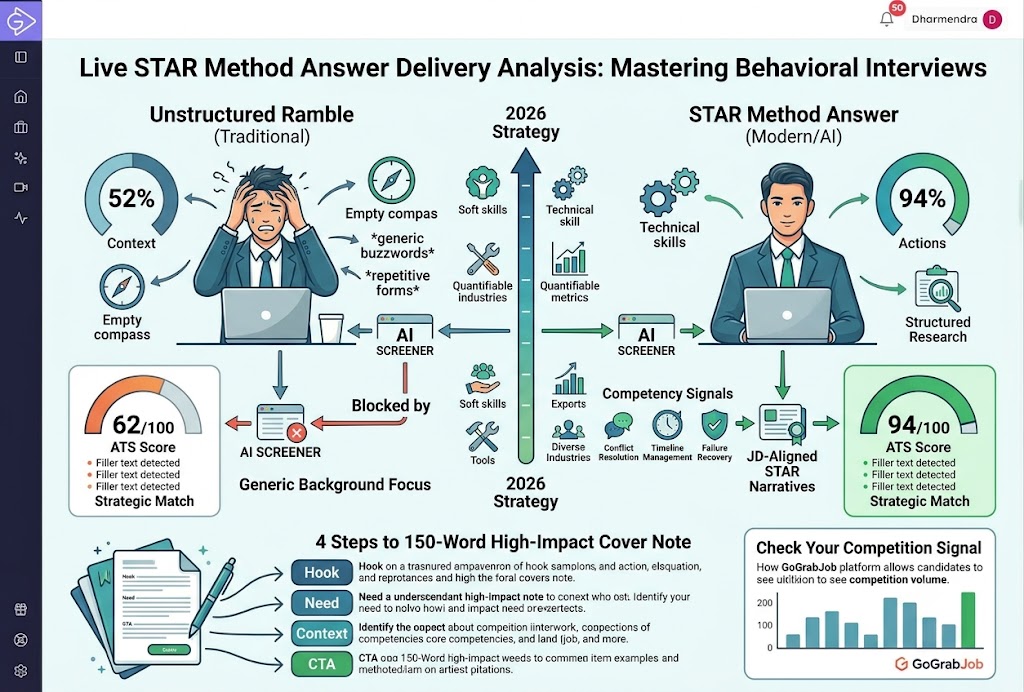
Understanding the STAR Method for Behavioral Interviews
Behavioral interviews have become the primary evaluation standard across top hiring hubs, from tech centers in Bengaluru and Gurugram to multinational corporations worldwide. Rather than asking hypothetical questions about what you might do in a situation, interviewers use behavioral questions to examine what you have actually done. This practice relies on a proven premise: past behavior and problem-solving patterns are the single best predictors of future job performance.
Phrases like "Tell me about a time when you managed a tight deadline," "Describe a situation where you led a team through change," or "Give me an example of a project that failed" test your practical problem-solving skills, accountability, and communication under pressure. Without a structured formula, candidates frequently make the mistake of rambling, focusing too much on generic background details, or omitting the specific actions they personally took to achieve an outcome.
This is where studying behavioral interview STAR method examples becomes indispensable. The STAR technique organizes your narrative into four concise components:
- Situation: The background context, challenge, or environment you were operating in.
- Task: Your specific responsibility, objective, or goal in that scenario.
- Action: The concrete steps, decisions, and strategies you personally executed.
- Result: The measurable outcome, impact on the business, and key learnings.
By converting your career achievements into structured STAR modules, you ensure every response directly answers the interviewer's intent while highlighting competencies directly relevant to the target role. Practicing these structured narratives helps you project confidence, maintain focus, and communicate value during high-stakes selection rounds.
Real-World STAR Method Examples for Common Behavioral Questions
To build responses that resonate, it helps to examine real-world behavioral interview STAR method examples across common work scenarios. The following examples demonstrate how to structure answers for leadership, high-stress delivery, and handling setbacks.
Example 1: Resolving Team Conflict Under Deadline Pressure
- Situation: During a core system upgrade at my previous firm, two senior developers had conflicting views on whether to use a monolithic refactor or a microservices architecture, stalling sprint momentum for five business days.
- Task: As the technical lead, I needed to resolve the architectural disagreement, realign the team, and keep the product launch on schedule within a strict two-week window.
- Action: I organized a focused two-hour evaluation session where both developers presented architectural trade-offs using standardized evaluation criteria like deployment speed and maintenance cost. Recognizing that a hybrid approach satisfied our immediate throughput requirements while leaving room for scalability, I drafted a compromise architectural blueprint and reassigned sprint deliverables according to each engineer's core strengths.
- Result: We completed the platform migration on time with zero unscheduled downtime. System throughput increased by 35%, and establishing clear decision-making criteria permanently reduced engineering friction across future sprints.
Example 2: Delivering Results Under Unrealistic Timelines
- Situation: An enterprise client requested custom integrations three weeks ahead of the original contract schedule, threatening to cancel a ₹25 Lakh contract if the revised launch date was missed.
- Task: I was tasked with reprioritizing the project engineering backlog to deliver functional, secure API endpoints without compromising current platform stability.
- Action: I conducted an immediate backlog review, deferred non-critical UI refactoring tasks, and divided the custom implementation into three milestone releases. I set up brief daily synchronization meetings with the client's engineering lead to resolve dependency blockers rapidly and introduced automated test scripts to accelerate quality assurance.
- Result: We delivered the core integration modules two days before the revised deadline. The enterprise customer renewed their contract for an additional two years, expanding total account revenue to ₹60 Lakhs.
Example 3: Overcoming a Critical Failure or Mistake
- Situation: Following a major user interface overhaul, our onboarding conversion rate dropped by 22% during its initial deployment week.
- Task: I had to identify the root cause of user drop-off, implement fixes, and restore onboarding conversion rates within seven days.
- Action: I reviewed product analytics telemetry alongside incoming support tickets. I discovered that a mobile browser authentication step was failing silently on low-bandwidth connections. I immediately coordinated a rollback of that specific authentication step to a legacy fallback mechanism while guiding our mobile developers through a targeted hotfix.
- Result: Conversion rates recovered within 48 hours and reached an all-time high of 84% once the optimized hotfix was deployed, resulting in a overall 12% improvement over original baseline metrics.
Stay Updated
Get the latest career insights and job search tips delivered to your inbox.
We'll only email you about new blog posts. Unsubscribe any time.
4 Steps to Build Your STAR Method Response
- 1
Audit the Job Description for Key Competencies
Examine the job description to identify recurring themes such as cross-functional leadership, conflict management, budget optimization, or rapid execution.
- 2
Isolate High-Impact Career Stories
Select 5 to 7 pivotal career moments that demonstrate core competencies, ensuring each situation involves clear challenges and measurable stakes.
- 3
Draft Clear Action Statements Focused on Your Personal Impact
Detail the exact actions you took using active verbs. Focus on your individual contribution using 'I' statements rather than general 'we' statements.
- 4
Quantify Results with Data and Retrospective Learnings
Conclude each story with concrete figures such as percentage growth, revenue saved, time reduced, or strategic operational improvements.
Connecting Interview Prep to Your Application Pipeline
Effective interview preparation does not happen in isolation—it is an organic continuation of your overall job search strategy. Far too many candidates store application records in basic spreadsheets while keeping separate document files for interview notes, leading to fragmented context when recruiters call.
A structured workspace bridges the gap between initial job discovery and final interview rounds. When navigating modern hiring markets, discovering relevant opportunities in one ranked feed based on profile alignment enables you to prioritize companies where your background fits best. Evaluating applicant competition signals—such as recognizing when popular roles already have over 100 applicants—gives you early insight into how competitive your interview prep must be.
When managing your applications through GoGrabJob's unified workspace, every stage flows naturally into the next:
- Discovery to Tracking: Discover ranked job openings across global markets and move them into a single application tracking pipeline.
- Tailored Applications: Generate JD-tuned résumé versions for each application, establishing an ATS-optimized record of the precise skills and achievements you highlighted.
- Targeted Interview Prep: When moving an application to the interview stage, reference the exact keywords and metrics used in that specific résumé version to build tightly aligned STAR narratives.
By retaining every résumé iteration and linking it directly to your application pipeline, you can enter every interview fully prepared, speaking directly to the technical and behavioral requirements emphasized in the original job description.
STAR Answer Delivery Readiness Checklist
Did you establish clear background context (Situation) in under 30 seconds?
Is your personal role and primary goal (Task) distinctly highlighted?
Does the core of your response focus heavily on your specific actions (Action)?
Did you state concrete metrics, percentages, or financial figures in the outcome (Result)?
Did you avoid non-specific statements by using strong action verbs ('led', 'architected', 'resolved')?
Is your story structured to be delivered within a 90-to-120-second timeframe?
Have you reviewed the job description to ensure your story highlights required core competencies?
Frequently asked questions
What if I don't have direct professional experience for a behavioral question?
If you are a fresher or making a career transition, draw examples from academic group projects, open-source initiatives, freelance assignments, or leadership roles in student organizations. Focus on demonstrating transferable competencies such as structured problem-solving, adaptability, analytical thinking, and collaboration. As long as you clearly articulate your personal role and quantify the final outcome, non-traditional experiences offer strong evidence of capability.
How long should a STAR method response be in an interview?
An ideal STAR response lasts between 90 seconds and two minutes. A common mistake candidates make is spending 70% of their time describing background details. Structure your delivery so that 20% covers the Situation and Task combined, 60% highlights your personal Actions, and 20% delivers the quantitative and qualitative Results.
Can I use the same STAR story for multiple behavioral interview questions?
While a major accomplishment can showcase multiple core competencies, avoid repeating the exact same story across rounds with the same hiring team. Prepare a versatile repository of 5 to 7 strong career stories covering fundamental themes such as conflict resolution, overcoming failure, managing tight timelines, and technical leadership. You can adapt the emphasis of individual stories depending on the competency highlighted by the interviewer.
Run your job search in one workspace
Find roles ranked to your profile, tailor your existing resume for each job, score ATS fit, and track applications — free to start.