The Strategic Mindset: Transitioning from Learner to Achiever
Landing your first job in India—whether in tech hubs like Bengaluru, Pune, and Hyderabad, or within global capability centers (GCCs) across NCR—is a major milestone. However, the initial 12 to 24 months in the workforce often present a steep learning curve. Many early-career professionals fall into the trap of remaining in passive execution mode, waiting for managers to hand out assignments rather than actively steering their career trajectory. Establishing a concrete career growth plan after first job India is the single most effective way to prevent skill stagnation and ensure continuous salary progression.
During your first year, the primary objective shifts from basic onboarding to establishing measurable output. Workplace dynamics in Indian enterprises and high-growth startups value professionals who demonstrate proactive problem-solving, domain competence, and clear cross-functional communication. Instead of simply completing assigned tickets or operational tasks, document the business impact of your work. Did your refactoring reduce load times by 20 percent? Did your client coordination accelerate project delivery timelines? Tracking these concrete outcomes provides the foundational evidence required for internal performance reviews or external job transitions.
Furthermore, developing a strategic mindset involves understanding the broader ecosystem of your industry. Identifying high-demand skill sets—such as cloud architecture, data analytics, product management, or specialized domain engineering—allows you to align your daily responsibilities with long-term market trends. Relying solely on company-provided training is rarely enough; proactive self-skilling combined with structured project ownership establishes your reputation as a high-performing contributor ready for senior responsibilities.
Building a Phased 3-Year Career Growth Roadmap
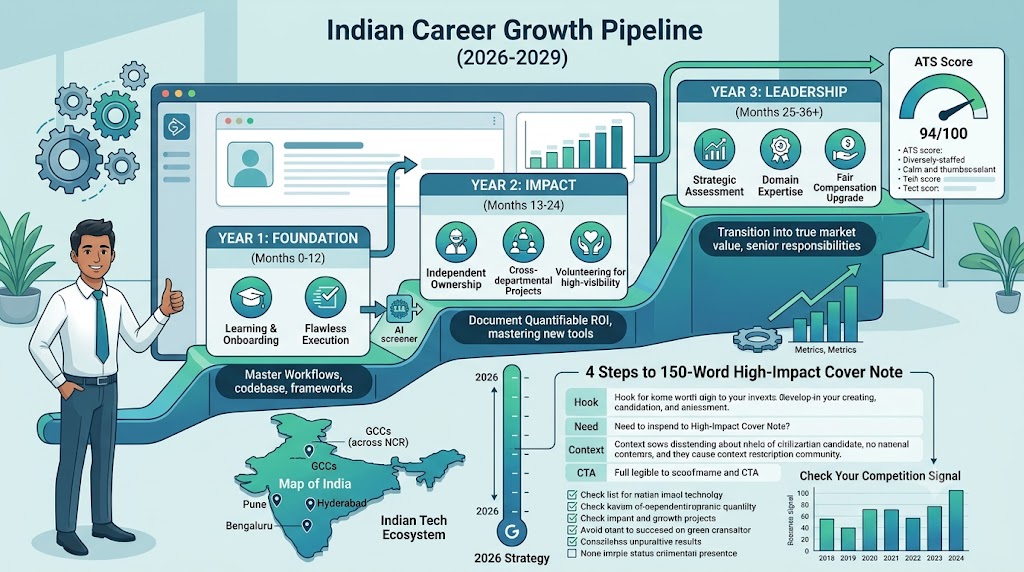
A successful career growth plan after your first job relies on a structured timeline broken into clear phases. Rather than setting vague goals like 'getting promoted,' divide your early career into three strategic phases spread over 24 to 36 months to maintain focus and accountability.
Phase 1: Foundation and Execution (Months 0–6) Focus heavily on absorbing core workflows, understanding team dynamics, and delivering assigned tasks flawlessly. Focus on understanding the codebase, business logic, or operational frameworks deeply. Seek feedback early from mentors and team leads to correct mistakes and build a reputation for reliability.
Phase 2: Expansion and Quantifiable Impact (Months 7–18) Transition from supervised execution to independent ownership. Volunteer for complex modules, cross-departmental initiatives, or high-visibility projects. Begin building a dedicated career ledger where you log every key achievement, tool mastered, process improvement, and financial or operational metric you impacted. This data becomes vital when negotiating promotions or updating your résumé.
Phase 3: Strategic Assessment and Progression (Months 19–36) At this stage, evaluate your trajectory objectively. Assess whether your current organization offers clear pathways for upward mobility, fair compensation upgrades, and continuous learning. If internal advancement stalls due to rigid corporate structures or budget constraints, it is time to look outward. Research current market demands, benchmark your skill set against mid-level job roles, and prepare to transition into a position that reflects your true market value.
Stay Updated
Get the latest career insights and job search tips delivered to your inbox.
We'll only email you about new blog posts. Unsubscribe any time.
5 Steps to Execute Your Post-First-Job Growth Strategy
- 1
Audit Your Current Competencies
Compare your actual skill set against job descriptions for mid-level roles (2-4 YOE) in your target industry.
- 2
Build a Documented Impact Portfolio
Log specific metrics, project outcomes, cost savings, and technical implementations completed during your first job.
- 3
Curate a Profile-Matched Search Strategy
Move away from spray-and-pray job applications by using AI platforms that aggregate multi-platform listings into one ranked feed.
- 4
Tailor Résumés and Monitor Live ATS Scores
Customize your résumé for every targeted role, keeping track of tailored versions and optimizing against job description keywords.
- 5
Prepare End-to-End for Technical & Behavioral Interviews
Convert matching applications into structured pipelines, moving seamlessly from application tracking to targeted interview preparation.
Levelling Up Your Job Search: Precision Applications and ATS Optimization
When you decide to seek your second role, standard application methods often fall short. Mass-sending generic résumés across multiple independent career portals leads to low callback rates and application fatigue. To secure high-quality offers, you must transition from unstructured searching to a streamlined application workspace.
Modern job seekers benefit significantly from centralized discovery hubs that collect opportunities across multiple job sources into a single ranked feed. Rather than manually scanning dozens of sites daily, prioritizing roles based on actual profile fit ensures that your efforts go toward opportunities where you stand out. Additionally, paying attention to applicant competition signals—such as knowing when a job posting has already accumulated over 100 applicants—helps you decide whether to apply immediately or focus on fresh, less saturated roles.
Optimizing your application materials is equally critical. Employers in India utilize Applicant Tracking Systems (ATS) to filter hundreds of early-career applicants. Customizing your résumé to match specific job description keywords using live ATS scoring tools dramatically improves your chances of passing automated filters. Maintaining a platform that remembers every distinct résumé version created per application prevents confusion when recruiters schedule surprise screening calls.
By managing your move inside a unified pipeline—where discovery, application tracking, ATS customization, and interview preparation operate seamlessly together—you take full control of your career path without relying on luck or guarantees.
First-Job Growth Plan Readiness Checklist
Documented at least 5 major projects with quantifiable metrics (KPIs, revenue, efficiency gains).
Identified top 3 skill gaps required for the next tier (e.g., Senior Analyst, Software Engineer II).
Updated résumé tailored specifically to target job descriptions with high live ATS scores.
Organized application history and custom résumé versions in a single tracking pipeline.
Practiced structured interview responses (STAR method) for behavioral and technical rounds.
Frequently asked questions
How long should I stay in my first job in India before switching?
While there is no rigid rule, staying between 18 to 24 months in your first job is generally recommended in the Indian market. This duration demonstrates stability to prospective employers while providing sufficient time for you to own end-to-end projects, build measurable achievements, and master core domain skills. Swapping roles under 12 months repeatedly can raise stability concerns unless the move is driven by exceptional growth opportunities or company restructuring.
How does live ATS scoring help during a career transition?
Applicant Tracking System (ATS) software automatically scans incoming résumés for relevant keywords, technical proficiencies, and experience metrics specified in the job description. Utilizing live ATS scoring tools allows you to benchmark your tailored résumé against the target job description before submitting. This ensures your key achievements and technical terms are properly formatted and highlighted, maximizing your application's visibility to hiring teams.
Should I focus on an internal promotion or an external job move for my second role?
Both paths have distinct advantages. An internal promotion validates your performance within your current organization, preserves your organizational domain knowledge, and provides a title upgrade that strengthens your profile. However, external moves often result in higher percentage compensation increases in the Indian market. Evaluate your current company's growth trajectory and promotion timelines; if internal pathways are blocked, an external job search using an organized application workspace is usually the best option.
Run your job search in one workspace
Find roles ranked to your profile, tailor your existing resume for each job, score ATS fit, and track applications — free to start.