The Shifting Role of Cover Letters in Modern Recruitment
The job search landscape in 2026 operates at unprecedented velocity. Recruiters receive hundreds of applications within hours of posting a role, particularly across tech hubs in Bengaluru, Gurgaon, and global remote channels. In this environment, the traditional two-page formal cover letter has largely been phased out. Modern hiring managers spend an average of six to eight seconds on an initial application scan. If your cover letter is a generic three-paragraph essay repeating the bullet points of your résumé, it will almost certainly be ignored.
However, saying cover letters are completely dead is an oversimplification. What has changed is their format and function. Employers no longer read lengthy narratives introducing yourself; instead, they scan for context that a structured résumé cannot easily convey. In fast-paced markets, hiring managers use cover letters to answer specific questions: Why are you transitioning between industries? Why is there a gap in your employment history? Why are you moving from a global corporation to an early-stage startup?
When competition for posted positions skyrockets—with popular roles accumulating 100+ applicants in a single afternoon—a generic cover letter adds zero value. Conversely, a brief, targeted note that immediately addresses the core challenge mentioned in the job description can set you apart. Rather than viewing the cover letter as a mandatory formality, top candidates treat it as a strategic, highly contextual attachment designed to answer the recruiter's unstated hesitations.
When a Cover Letter Matters—and When You Can Skip It
Knowing when to spend time writing a cover letter is essential for maintaining high application momentum. Spending forty-five minutes crafting a custom letter for every single job submission creates unnecessary burnout and drastically reduces your total output. Strategic job seekers evaluate the role, company size, and application requirements before deciding whether to include one.
Scenarios Where You Should Always Include a Cover Letter
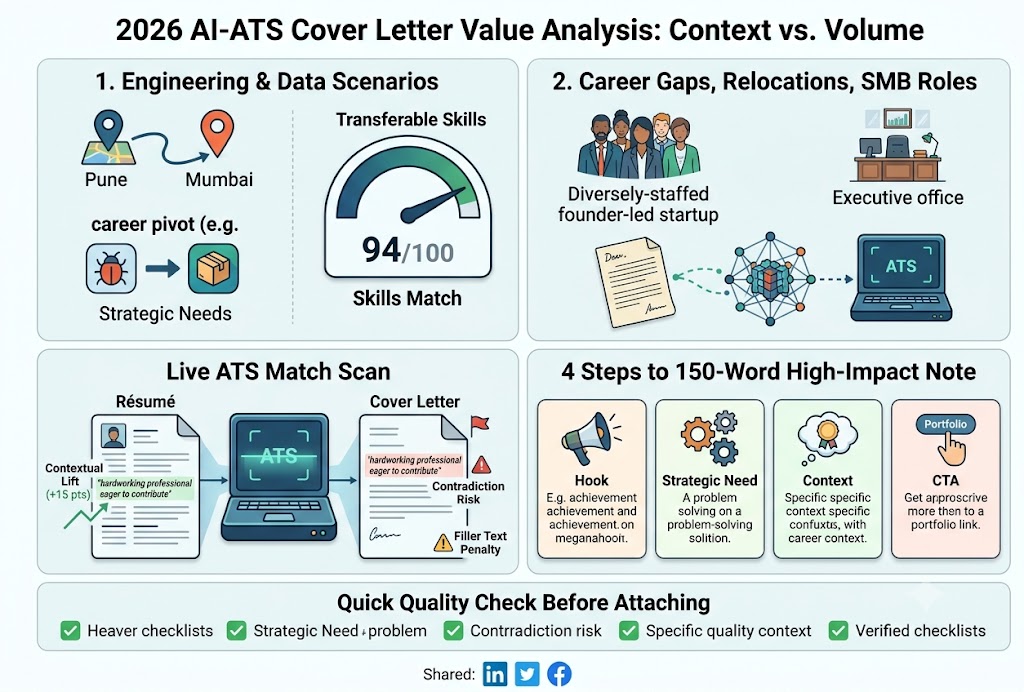
- Career Transitions and Shift in Track: If you are pivoting from software QA to product management, your résumé highlights past duties that may not immediately match the target title. A short cover letter bridges the gap by emphasizing transferable problem-solving skills.
- Relocation or Specific Location Preferences: If you are applying for a hybrid role in Mumbai while currently residing in Pune or Chennai, recruiters may reject your profile assuming you are unsuited for the office requirement. A quick sentence clarifying your relocation timeline eliminates this friction.
- Small to Mid-Sized Businesses and Executive Roles: Early-stage startups and boutique consultancies value company alignment and culture fit heavily. Founder-led teams are far more likely to read cover letters than high-volume corporate sourcing squads.
- Explicitly Required by the Application: If the submission form features an mandatory attachment field or custom prompt, skipping it signals a lack of attention to detail.
Scenarios Where You Can Safely Skip the Cover Letter
- High-Volume Technical Roles: Engineering, data analytics, and DevOps positions rely predominantly on technical assessments, GitHub repositories, and structured skill matrices. An ATS screen will prioritize your tech stack over introductory prose.
- Mass Hiring Portals with Optional Fields: When applying to standardized high-volume openings where speed is critical, submitting a perfectly tailored résumé immediately is far more effective than delaying your application to write prose.
How ATS and AI Screeners Evaluate Your Application Package
Modern Applicant Tracking Systems (ATS) and AI talent screeners parse both résumés and supplementary cover letters, but they process them differently. Understanding this mechanism prevents candidates from falling into common optimization traps.
When you upload a cover letter file alongside your résumé, the ATS extracts raw text from both documents to populate candidate attribute fields. While primary algorithms prioritize structured fields—such as job titles, years of experience, educational degrees, and explicit technical skills—the cover letter is often scanned for secondary contextual keywords. If a company uses intelligent semantic search to rank applicants, relevant terminology inside your cover letter can marginally lift your contextual match score.
However, submitting a boilerplate, unedited cover letter full of generic phrases like 'hardworking professional eager to contribute' can actually work against you. AI matching algorithms detect low-information filler text. Furthermore, if your cover letter contains keywords that contradict the employment dates or skill proficiencies listed on your primary résumé, the parser may register data inconsistencies.
To ensure maximum readability across both automated systems and human recruiters, keep your cover letter short and structured. Use standard PDF or DOCX formats, standard fonts, and avoid placing key information inside graphics, tables, or header zones that automated screeners fail to parse.
Stay Updated
Get the latest career insights and job search tips delivered to your inbox.
We'll only email you about new blog posts. Unsubscribe any time.
4 Steps to Draft a 150-Word High-Impact Cover Note
- 1
Hook with Immediate Value
Skip standard pleasantries. Open directly with your strongest achievement or a direct hook that matches the core requirement of the job description.
- 2
Address the Strategic Need
Identify the primary challenge facing the hiring team (e.g., scaling database throughput, managing enterprise clients) and explain in two sentences how you solved a similar problem.
- 3
Provide Contextual Clarity
If applicable, address any potential questions regarding relocation, career transition, or immediate availability in a clear, positive statement.
- 4
Close with a direct Call to Action
Reiterate your enthusiasm for an interview discussion and provide a clean link to your portfolio or professional profile.
Quick Quality Check Before Attaching Your Cover Letter
Is the entire text under 175 words and readable in under 30 seconds?
Does it avoid repeating bullet points already listed on your main résumé?
Have you incorporated 2-3 specific technical or domain keywords from the job description?
Did you address specific context like notice period, relocation, or career pivot clearly?
Is the file saved in a clean, ATS-friendly format (.pdf or .docx) without complex graphics?
Integrating Cover Letters into an Automated Job Search Pipeline
Succeeding in today's job market requires balancing tailored application quality with consistent application volume. Expecting to manually write separate cover letters and customize documents for dozens of roles every week is unsustainable. Instead, smart candidates utilize centralized job search workspaces to streamline their end-to-end strategy.
By leveraging GoGrabJob, candidates can discover curated positions from multiple sources within a single ranked feed. Rather than engaging in blind application sprees, you can evaluate candidate match scores tailored directly to your profile. Seeing real-time applicant competition signals—such as knowing when a role already has over 100 applicants—helps you prioritize where a custom cover letter will deliver the highest return on investment.
When you decide to apply, GoGrabJob enables you to create a job-description-tuned résumé accompanied by a live ATS score check for every application. Every distinct version of your application materials is stored systematically within your personal pipeline. From initial discovery to application submission, tracking, and subsequent interview preparation, managing your assets in one workspace ensures you spend less time formatting documents and more time securing interviews.
Frequently asked questions
Do recruiters penalize candidates who do not submit a cover letter?
In most technical, analytical, and high-volume operations roles, recruiters do not penalize candidates for omitting a cover letter if it is marked optional. However, for client-facing, editorial, executive, or communications roles, failing to submit one when optional may be viewed as low effort compared to competing applicants.
Should I paste my cover letter into the email body or attach it as a PDF?
If you are applying via direct email outreach to a hiring manager, paste your condensed cover letter directly into the body of the email and attach your résumé. If you are uploading through an online applicant portal, upload it as a separate PDF or DOCX file only if an explicit field exists.
Can an AI-generated cover letter pass ATS checks?
Yes, ATS parsers read AI-generated text just like human-written text. However, human recruiters easily spot unedited, generic AI output filled with cliché buzzwords. If you use AI tools to assist your writing, always edit the output to ensure exact alignment with your real accomplishments and local communication style.
Run your job search in one workspace
Find roles ranked to your profile, tailor your existing resume for each job, score ATS fit, and track applications — free to start.