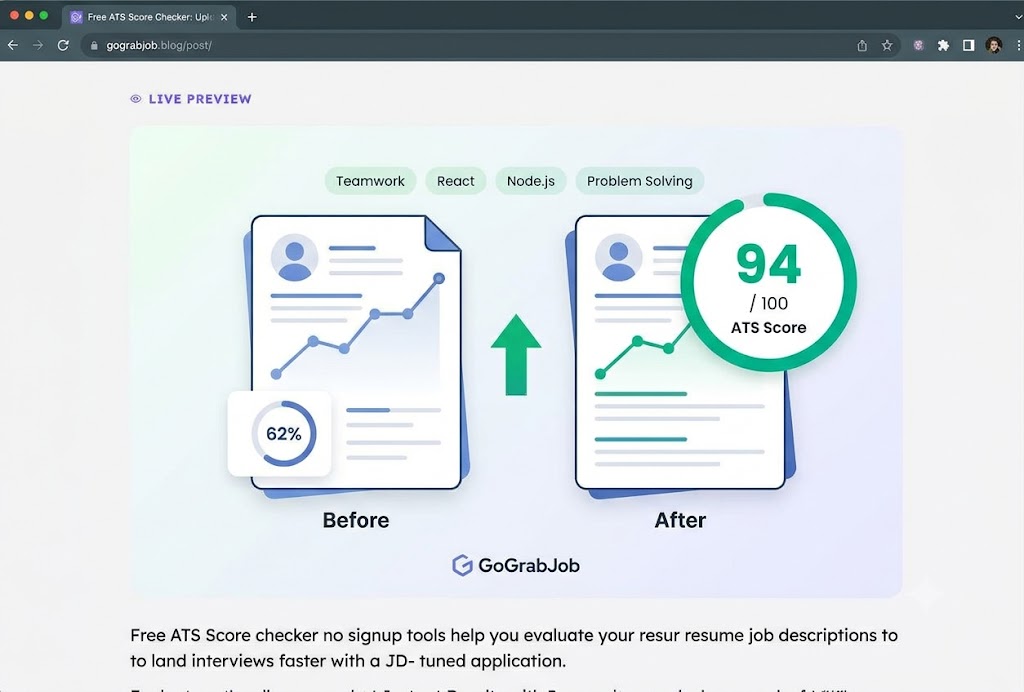
Understanding How Applicant Tracking Systems Evaluate Your Resume
Modern applicant tracking systems (ATS) serve as automated filters for corporate talent acquisition teams and recruitment agencies. Before a human recruiter ever sees your application, automated algorithms scan your document to extract structural text, match core competencies against the job description, and assign an internal alignment score. Using a free ATS score checker no signup tool allows job seekers to understand precisely how these algorithms parse their resumes, revealing structural flaws, unreadable formatting, or missing keyword clusters that might lead to an immediate automated rejection.
At its core, an ATS parses text into predictable fields such as work experience, education, skills, and contact details. When resumes contain complex graphics, multi-column tables, unstandardized fonts, or non-standard section headers, parsing errors occur. A parser might combine job titles with company names or completely drop essential experience blocks. Furthermore, applicant tracking software relies heavily on natural language processing to match specific phrases in the job requirements with terms present in your resume. If a job posting prioritizes specific technology stacks, management methodologies, or domain certifications, missing those exact terms lowers your calculated compatibility score.
Evaluating your document against actual job requirements reveals critical discrepancies before you submit. Rather than guessing why your applications vanish into an automated black hole, reviewing actionable ATS metrics enables you to resolve formatting errors and ensure key professional achievements are formatted cleanly for automated extraction systems.
Why Frictionless Resume Analysis Matters for Modern Job Seekers
Searching for a free ATS score checker no signup solution reflects a growing demand among candidate populations for fast, accessible, and transparent career tools. Traditional career platforms frequently block job seekers behind multi-step registration forms, mandatory credit card prompts, or complex onboarding questionnaires just to check basic document compatibility. When candidates apply to dozens of roles weekly, high friction tools slow down momentum and decrease total output. An immediate, unrestricted evaluation allows applicants to iterate on their resumes quickly and submit tailored applications within narrow posting windows.
Speed and efficiency are particularly vital in high-volume hiring markets like India, where competitive tech hubs in Bengaluru, Gurgaon, Hyderabad, and Pune see massive candidate volume. Popular engineering, product, and management job postings routinely draw hundreds of applicants within 24 to 48 hours of going live. When candidate pools swell rapidly, applicant competition signals indicate that positions often close early or prioritize early applicants whose resumes score highly in automated initial screenings. Having access to fast, frictionless score checking ensures you can adapt your resume immediately without losing valuable time.
However, a simple surface-level score check is only the first step. To consistently convert applications into interviews, job seekers must connect ATS match checking directly into an organized job search pipeline. Evaluating a resume in isolation without comparing it to a specific target job description provides limited context. Real optimization occurs when candidates benchmark their qualifications against the specific job descriptions of roles they actively intend to pursue.
How Tailored Resumes and Live Scoring Improve Your Pipeline
Submitting a single, generic resume across dozens of varied job postings rarely yields strong response rates. Every organization emphasizes different technical skills, tools, and operational methodologies. A comprehensive workspace like GoGrabJob addresses this challenge by combining global job discovery with an integrated, JD-tuned résumé builder and live ATS scoring engine. By consolidating positions discovered across multiple career sources into one unified feed, candidates can evaluate roles, measure competition signals, and immediately calculate alignment scores for each opportunity.
When you target a specific role, our system calculates a live ATS score tailored specifically to that job description. As you edit your application to reflect missing key phrases, highlight relevant project accomplishments, or rephrase technical summaries, the real-time scoring module updates dynamically. Furthermore, because different roles require distinct emphasis, GoGrabJob automatically stores every resume version remembered per application. This approach ensures you maintain full version control across your entire job search pipeline without cluttering your local drive with endless PDF revisions.
This integrated workflow transitions your search from a high-volume, spray-and-pray method into a structured strategy. From initial role discovery and real-time ATS optimization to pipeline tracking and interview prep, managing your job hunt within a single application pipeline saves time, eliminates guesswork, and ensures every submitted application presents your strongest possible qualifications.
Stay Updated
Get the latest career insights and job search tips delivered to your inbox.
We'll only email you about new blog posts. Unsubscribe any time.
Optimizing Your Resume for Technical and Enterprise Roles in India
Candidate screening for technical and enterprise roles in India presents unique structural requirements that automated tools evaluate closely. Technical recruiters and enterprise ATS systems frequently look for specific details including educational institutions, precise tech stack variations, notice periods, and quantifiable project impact metrics. Using an ATS analyzer helps pinpoint whether your document successfully highlights these country-specific and industry-specific metrics in a format parsers can interpret correctly.
For example, software engineering candidates often list broad categories like 'full-stack development' while omitting specific framework versions, database technologies, or cloud infrastructure platforms mentioned in the job post. An automated parser evaluating a role requiring React, Node.js, and AWS architecture might penalize a resume that only mentions generic web development. Similarly, enterprise hiring workflows in banking, global capability centers (GCCs), and IT services look for precise operational keywords like Agile delivery, stakeholder management, microservices, and compliance standards.
To optimize effectively for these roles, ensure your resume balances keyword density with authentic achievement statements. Avoid keyword stuffing or adding white text, as modern screening systems flag unnatural keyword patterns immediately. Instead, weave required technical terms, frameworks, and tools directly into bullet points detailing measurable outcomes, such as performance improvements, revenue generation, or time saved.
Step-by-Step Guide to Optimizing Your Resume Match Score
- 1
Select Your Target Job Description
Copy the full text of the job description you want to target, including responsibilities, required skills, and preferred qualifications.
- 2
Run the ATS Analysis
Upload your current resume or paste your resume text alongside the job description to run an automated keyword and structural check.
- 3
Review Keyword Gaps and Formatting Errors
Examine the detailed breakdown of missing hard skills, soft skills, tool certifications, and formatting warnings flagged by the analyzer.
- 4
Refine Content and Update Application Version
Incorporate missing terminology naturally into your experience bullet points, ensuring your custom resume version is saved and tracked for that specific application.
Frequently asked questions
Can a free ATS score checker guarantee I will get an interview?
No system can guarantee job interviews or remove candidate competition on high-demand roles. An ATS score checker is a diagnostic tool designed to help you identify parsing errors, unreadable formats, and missing keywords in your resume relative to a job posting. While achieving a high match score ensures your application passes initial automated screening filters, final callback decisions depend on human recruiter evaluation, overall candidate competition, and professional background fit.
Why do ATS scores vary between different job descriptions for the same resume?
ATS match scores are calculated by comparing your resume directly against the specific terminology, hard skills, software tools, and qualifications listed in a particular job posting. Because every company writes unique job descriptions emphasizing different tools and methodologies, the same resume will produce varying alignment scores across different applications. Tailoring your resume to match each individual job description leads to higher score consistency.
How does version tracking help when managing multiple job applications?
When applying to multiple roles across diverse companies, tailoring your resume results in numerous unique documents. Without organized version tracking, remembering which specific skills or project highlights you emphasized for a given application becomes difficult during interview rounds. GoGrabJob automatically links and remembers every custom resume version per application within your unified tracking pipeline, allowing you to review your exact submitted application prior to interviews.
Run your job search in one workspace
Find roles ranked to your profile, tailor your existing resume for each job, score ATS fit, and track applications — free to start.