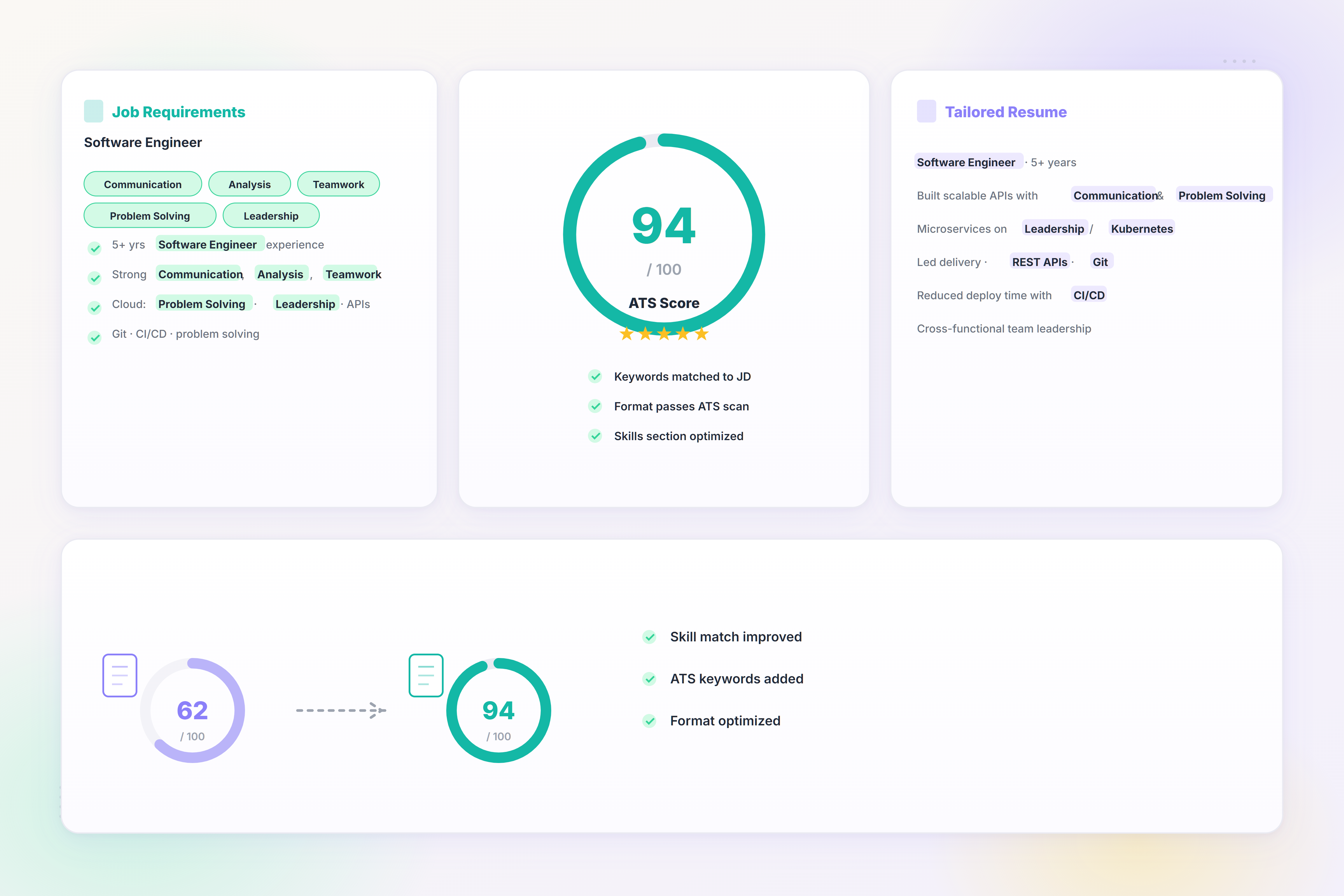
Why ATS Optimization Matters Before You Apply
In today's recruitment ecosystem, the majority of companies—from global enterprises to fast-growing startups across tech hubs like Bengaluru, Gurgaon, and Mumbai—use Applicant Tracking Systems (ATS) to filter job applications automatically. When you submit a resume, it is rarely viewed immediately by a human hiring manager. Instead, automated parsing algorithms process the document, strip away visual formatting, convert text into database entries, and calculate an initial relevance score based on the specific job description.
Understanding how to check ATS score before applying is critical because candidate pools are larger than ever. A single opening for a Software Engineer, Marketing Manager, or Data Analyst can easily draw hundreds of submissions within forty-eight hours. If your resume lacks exact keyword matches, utilizes non-standard section headers, or contains complex formatting elements like embedded multi-column tables, the parser may fail to read your qualifications accurately. Consequently, your profile could receive a low automated match score and end up buried deep in the applicant queue, regardless of how qualified you actually are for the role.
Pre-checking your resume score allows you to identify missing technical skills, mismatched terminology, or formatting errors while you still have time to fix them. Rather than relying on a standardized resume across fifty different job openings, analyzing your score beforehand helps you fine-tune your document to align directly with what the employer is seeking. Taking a deliberate, targeted approach significantly improves your visibility in recruiter search feeds, ensuring that your real-world experience and accomplishments receive the human evaluation they deserve.
4-Step Process to Check and Improve Your Resume Match Score
- 1
Extract Core Keywords from the Job Description
Carefully review the target job posting to identify required hard skills, tools, methodologies, and specific job titles (e.g., 'Node.js', 'Project Management', 'Agile Delivery').
- 2
Compare Resume Terminology Against the Role Requirements
Ensure your resume uses the exact phraseology found in the job description. If a company lists 'Search Engine Optimization', avoid shortening it solely to 'SEO'.
- 3
Analyze Format Parsability
Strip out complex text boxes, multi-column layouts, graphics, and non-standard fonts that cause parsing errors in automated recruitment software.
- 4
Run a Live ATS Match Check
Evaluate your customized resume against the specific job description using a live scoring tool to ensure critical skill gaps are filled before submitting.
Key Factors Evaluated by ATS Scoring Engines
When an Applicant Tracking System scans your resume against a target job description, it doesn't just read words—it categorizes your career history into structured data points. Understanding the underlying metrics that drive ATS scoring algorithms enables you to optimize your document effectively before pushing your application live.
1. Hard Skill and Technical Keyword Alignment
Hard skills are the most critical signal for automated screening engines. If a company in India is hiring a Cloud Architect and specifies requirements for AWS, Kubernetes, Terraform, and Python, the ATS actively scans your document for those exact character strings. Missing two or three mandatory technical skills directly reduces your calculated relevance percentage. Ensure these keywords appear naturally in context within your work experience bullet points rather than as a disconnected block of text.
2. Job Title and Experience Match
ATS engines evaluate structural alignment between your past job titles and the target position title. If you are applying for a 'Senior Product Manager' position but your resume lists your current title as 'Lead Product Strategist', the algorithm may penalize the match strength. Where truthful, adjusting your header titles or adding parenthetical clarifications (e.g., 'Lead Product Strategist / Senior Product Manager') helps the system recognize your seniority and function immediately.
3. File Structure and Standard Section Headings
Parsers rely on standard header conventions to organize your resume data into correct fields such as Work Experience, Education, and Skills. Creative headings like 'Where I Have Made an Impact' or 'My Learning Journey' often confuse ATS software, leading to omitted experience entries. Stick to standard titles like 'Professional Experience', 'Technical Skills', and 'Education'. Additionally, submit your resume in standard .docx or vector-based PDF formats without embedded images or decorative graphic bars.
Stay Updated
Get the latest career insights and job search tips delivered to your inbox.
We'll only email you about new blog posts. Unsubscribe any time.
Essential ATS Pre-Submission Checklist
Target job title matched accurately in resume headline or summary
Exact keyword phrases incorporated from the requirements list
Clean single-column layout without embedded text boxes or images
Standard headings used (e.g., Work Experience, Skills, Education)
Reverse-chronological work history format with clear start/end dates
Live ATS score evaluated against the specific job description
Tailored resume version saved and mapped to this specific application
Streamlining ATS Scoring in Your Job Search Workspace
Managing dozens of tailored resume variations across multiple job boards manually quickly leads to disorganization. Effective candidate strategy relies on an integrated workflow that combines role discovery, ATS scoring, and application tracking into a centralized space. Rather than juggling separate text editors, external keyword density tools, and local file folders, modern job seekers benefit from a unified workflow.
Using GoGrabJob, you can discover open roles aggregated from multiple platforms into one ranked feed tailored specifically to your background. When you select an interesting position, you can utilize the JD-tuned résumé generator to produce a tailored resume mapped directly to that exact role. The platform displays a live ATS score for every application, surfacing missing keywords and highlighting formatting alignments before you hit apply.
Furthermore, GoGrabJob remembers every distinct resume version created for each application within your integrated pipeline—taking you seamlessly from job discovery to application tracking and interview preparation. While optimizing your ATS score dramatically improves parsing accuracy and alignment with role requirements, it is essential to keep realistic expectations. On competitive openings that attract 100+ applicants within hours, an optimized ATS score ensures your application is accurately indexed and reviewed, though standing out ultimately requires submitting early and showcasing clear, quantifiable professional achievements.
Frequently asked questions
What is considered a good ATS score before submitting an application?
Most recruiters consider an ATS match score of 75% or higher to be a strong match for screening purposes. A score above 80% indicates that your resume aligns tightly with mandatory keywords, required skills, and job titles listed in the job posting.
Why shouldn't I use visual graphics or multi-column resume templates?
Applicant Tracking Systems parse documents from left to right and top to bottom. Multi-column templates, embedded images, progress bars, and complex tables often cause the parser to read text out of order or ignore entire sections, resulting in lost information and a lower ATS score.
Does reaching a high ATS score guarantee an interview call?
No tool or score can guarantee an interview call. An ATS score reflects how well your resume matches the job description's keywords and structural formatting. Final hiring decisions always depend on human recruiter evaluation, overall candidate competition volume, and specific hiring team priorities.
Run your job search in one workspace
Find roles ranked to your profile, tailor your existing resume for each job, score ATS fit, and track applications — free to start.