Understanding the Core Differences in Expectations
The modern employment landscape is fundamentally split between hybrid arrangements and fully remote positions. A successful hybrid vs remote job search strategy begins with understanding how talent acquisition teams evaluate candidates for each work model. While both offer flexibility compared to traditional five-day office routines, their operational requirements, candidate pools, and evaluation metrics differ significantly.
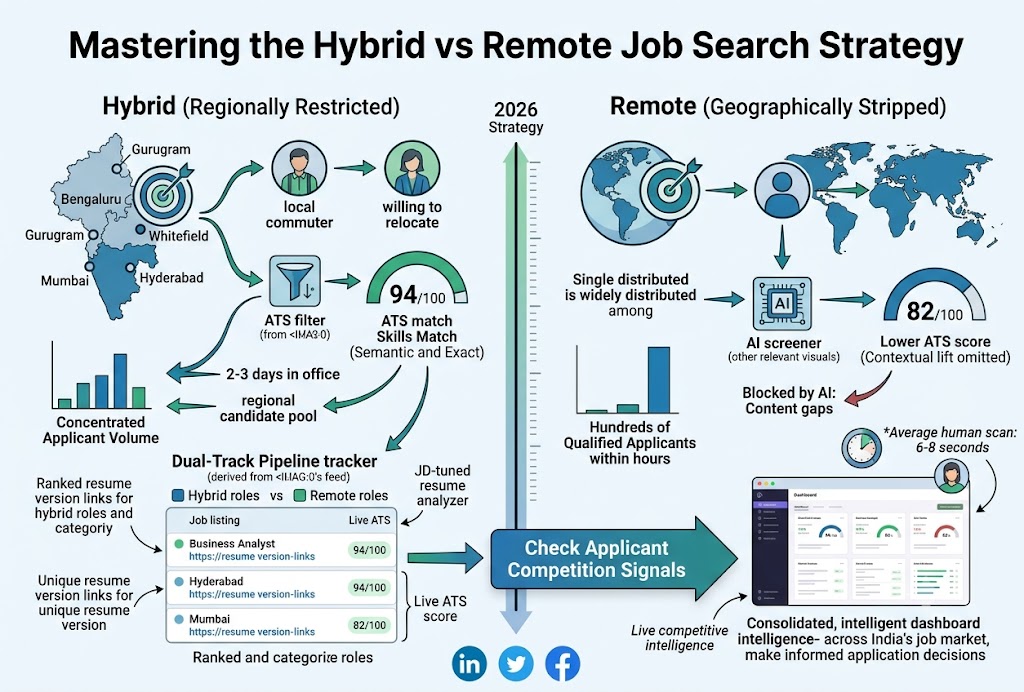
Hybrid positions typically require candidates to reside within reasonable commuting distance of corporate hubs like Bengaluru, Gurugram, Hyderabad, or Mumbai. Recruiters targeting hybrid candidates place heavy emphasis on geographic proximity, logistics, and in-person collaboration skills. Because the candidate pool is geographically restricted to regional commuters or candidates actively willing to relocate, the applicant volume for hybrid positions is often more concentrated. Hiring managers evaluate whether your schedule, commuting tolerance, and local presence align with their required days in office—often 2 to 3 days per week.
Conversely, fully remote roles strip away geographic boundaries across India or worldwide. While this expands your opportunity horizon, it simultaneously exposes you to a vastly larger talent pool. A single remote software engineering or marketing opening can attract hundreds of qualified applicants within hours. Recruiters reviewing remote candidates focus intensely on asynchronous communication skills, documented self-management, proficiency with distributed collaboration tools, and time-zone alignment. Failing to tailor your approach to these distinct recruiter mindsets often results in missed opportunities and lower response rates across your application pipeline.
Tailoring Your Résumé for Hybrid vs Remote Roles
Submitting a generic résumé to both hybrid and remote roles severely undermines your response rate. Automated Applicant Tracking Systems (ATS) and human screeners look for specific signals depending on the working model. Implementing a precise hybrid vs remote job search strategy means maintaining customized versions of your profile that align directly with each job description's implicit and explicit requirements.
For hybrid positions, your application must prominently feature location compatibility. Include your city and state clearly in the header, and explicitly mention your willingness to work on-site in key business districts such as Whitefield, Cyber City, or BKC if applicable. Highlight accomplishments that demonstrate effective cross-functional team management, workshops, or physical site coordination. Emphasize how you balance high-focus independent tasks with high-impact collaborative in-office days.
For fully remote positions, your résumé must showcase digital autonomy and mastery of remote operational frameworks. Keywords like asynchronous communication, distributed project management, cross-time-zone collaboration, and self-directed problem solving should be seamlessly integrated into your bullet points. Mention specific tooling expertise such as Jira, Notion, Slack, and asynchronous video communications. Using GoGrabJob, you can instantly generate a JD-tuned résumé that calculates a live ATS score tailored specifically to the remote or hybrid posting. Crucially, the platform remembers every single résumé version tied to each specific application, ensuring you never mix up tailored documents when recruiters reach out for initial screening calls.
Stay Updated
Get the latest career insights and job search tips delivered to your inbox.
We'll only email you about new blog posts. Unsubscribe any time.
Execution Steps for Dual-Track Job Applications
- 1
Categorize Opportunities by Work Model
Filter incoming roles into distinct buckets: local hybrid roles within commuting distance, national remote roles within India, and international remote roles requiring specific time-zone overlaps.
- 2
Optimize Keyword Alignment Per Listing
Run each job description through GoGrabJob's JD-tuned résumé analyzer to evaluate your live ATS match score before applying. Adjust keywords for local proximity or remote tooling.
- 3
Evaluate Application Competition Signals
Check applicant density signals on target roles. Prioritize applying immediately to newly posted remote positions where competition is rapidly building beyond 100+ applicants.
- 4
Track Applications in a Single Pipeline
Organize every hybrid and remote submission within a unified tracker from initial discovery to active interview stages, keeping customized resume versions linked to each entry.
Navigating Competition Signals and Pipeline Tracking
A critical aspect of an effective hybrid vs remote job search strategy is managing high applicant volumes and strategic timing. Popular fully remote positions frequently receive over 100 applications within the first 24 to 48 hours of posting. Spray-and-pray tactics—mass-submitting generic documents to hundreds of remote listings—rarely yield positive results and lead to job seeker burnout. Instead, candidates must rely on clear competitive intelligence and structured application management.
Understanding competition signals allows you to prioritize high-probability roles. When data indicates a remote position already has massive candidate volume, your tailored résumé must achieve a high ATS match score to stand out in the recruiter's queue. Alternatively, local hybrid roles may display lower overall competition signals due to location constraints, making them ideal targets for rapid follow-ups and localized networking.
GoGrabJob simplifies this complex balancing act by providing a single consolidated feed that aggregates roles across platforms into ranked matches based on your unique profile. Rather than maintaining fragmented spreadsheets, you can track every role through a structured pipeline—from initial discovery and ATS optimization to application tracking and interview prep. While no system can guarantee interviews or eliminate competition on hot roles, prioritizing ranked fit over volume gives you a distinct advantage in today's dynamic employment market.
Strategic Checklist for Hybrid and Remote Seekers
Include your physical location or target relocation city clearly on hybrid applications.
Highlight remote tools (e.g., Slack, Jira, Notion) and asynchronous work achievements for remote roles.
Check the live ATS match score against the exact job description before submitting.
Monitor applicant competition signals to apply early to rapidly growing remote postings.
Keep track of tailored résumé versions linked to every individual application.
Prepare specific interview examples for both remote self-direction and hybrid team collaboration.
Frequently asked questions
Should I use different résumés for hybrid and remote positions?
Yes, tailored résumés significantly increase your interview conversion rate. Hybrid applications should emphasize physical proximity, willingness to commute, and in-person team leadership. Remote applications should focus on asynchronous communication, remote collaboration tools, self-directed output, and proven experience working independently across time zones.
How do I handle location requirements for remote roles based in India?
Many remote roles are restricted to specific tax jurisdictions or time zones, such as 'Remote - India' or 'Remote - GMT+5:30'. Ensure your profile and résumé explicitly state your current work authorization and primary location to clear automated ATS screening filters before your application reaches hiring teams.
Is applicant competition higher for fully remote roles compared to hybrid roles?
In most cases, yes. Fully remote positions attract candidates nationwide or globally, quickly generating hundreds of applicants. Hybrid positions restrict the candidate pool to local commuters, resulting in lower applicant volume but requiring higher location alignment. Utilizing competition signals helps you decide when to apply immediately.
Run your job search in one workspace
Find roles ranked to your profile, tailor your existing resume for each job, score ATS fit, and track applications — free to start.