Demystifying Job Match Percentages in Modern Search Workspaces
In today’s technology-driven hiring landscape, job seekers frequently encounter numerical scores next to job listings. Understanding the job match percentage meaning is essential for navigating modern recruitment platforms and AI-powered workspaces. At its foundation, a job match percentage is an algorithmic evaluation that compares your professional profile—including your technical skills, work experience, education, tools, and job preferences—against the explicit and implicit requirements listed in a specific job description (JD).
Rather than forcing applicants to manually read hundreds of posting details to guess if they are qualified, automated smart-matching systems parse both the candidate data and the job text to generate a compatibility rating. A match percentage of 85%, for example, indicates that your background satisfies a significant majority of the core criteria specified by the employer, such as required coding languages, project management certifications, or years of domain experience.
Historically, candidates engaged in a high-volume 'spray-and-pray' strategy—submitting identical résumés to dozens of open roles across various job boards each day. This strategy frequently led to low response rates, burn out, and application fatigue. Modern job search workspaces transform this paradigm by discovering roles across platforms and aggregating them into a single, personalized feed ranked by fit. By calculating weighted match metrics instantly, candidates can bypass roles with poor alignment and immediately focus their effort where their qualifications stand out.
In competitive hiring hubs across India and globally—from tech centers like Bengaluru, Hyderabad, and Gurgaon to international remote talent pools—a high match score serves as your initial signal to apply. It helps you quickly identify roles where your current skill set gives you a natural advantage, while also highlighting potential skill gaps you may need to address in your application materials.
The Core Components Behind Match Algorithms and ATS Compatibility
To fully understand what your match percentage represents, it is important to examine the underlying mechanics of Applicant Tracking Systems (ATS) and job search scoring engines. Match algorithms do not merely look for exact word matches; they utilize natural language processing (NLP) to evaluate semantic context, industry relationships, and depth of qualification.
1. Hard Skills and Technical Competencies
The heaviest weight in any match calculation usually rests on hard skills. If a job posting demands expertise in Python, SQL, AWS, and system design, the matching engine scans your profile and résumé for these exact terms as well as related frameworks and tools. The closer your documented skills match the required tech stack or toolset, the higher your score rises.
2. Experience Level and Seniority Mapping
Algorithms evaluate context beyond keywords. They analyze your career timeline, title hierarchy, and total years of experience against the level requested in the job description. An applicant with three years of experience applying for a Principal Architect position requiring twelve years will receive a scaled reduction in their match score, reflecting the seniority gap.
3. Contextual Keyword Density and ATS Readiness
When submitting an application, employer ATS scanners parse your file to ensure key terms appear in meaningful contexts (such as bullet points detailing specific achievements) rather than isolated skill lists. Advanced job workspaces provide a live ATS score alongside the raw match percentage, giving you real-time visibility into how well your customized document will parse through employer screening filters.
4. Applicant Competition Signals
A complete evaluation of an opportunity involves looking at the match score in tandem with applicant competition data. Even if you hold a pristine 92% match score, discovering that a popular role already has 100+ active applicants signals that speed and tailored materials are critical. Recognizing high competition allows you to prioritize rapid, high-quality submissions before candidate pools close.
Stay Updated
Get the latest career insights and job search tips delivered to your inbox.
We'll only email you about new blog posts. Unsubscribe any time.
Key Elements Evaluated in a Job Match Score
Core Hard Skills: Direct alignment with mandatory technical tools and frameworks
Experience Tier: Years of relevant background compared to post requirements
Keyword Context: Presence of industry terminology within descriptive work achievements
Location and Work Mode: Compatibility with hybrid, remote, or city-specific demands (e.g., Bengaluru, Mumbai, NCR)
Education and Certifications: Possession of required degrees or specialized credentials
Strategic Playbook: How to Leverage Match Scores for Maximum Impact
Knowing the job match percentage meaning is only the first step; the real advantage comes from using these scores strategically across your job search pipeline. Treating match percentages as dynamic guidelines allows you to make informed decisions about where to spend your energy.
Interpreting Score Ranges
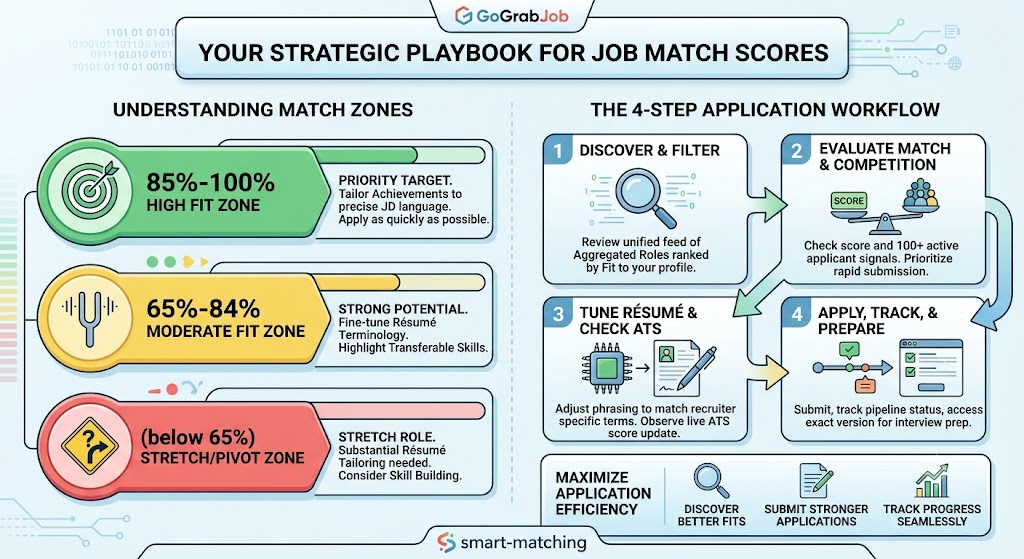
- 85% - 100% (High Fit): Priority targets. You meet or exceed nearly all requirements. Focus on tailoring your achievements to match the exact language of the JD and apply as quickly as possible.
- 65% - 84% (Moderate Fit): Strong potential opportunities. You possess the foundational capabilities but may be missing secondary preferences. Use JD-tuned résumé tailoring to highlight transferrable skills and bridge minor gaps.
- Below 65% (Low Fit): Stretch roles or misalignment. Evaluate whether you truly want to pivot into this space. If so, substantial résumé tailoring or skill building will be required prior to applying.
Leveraging JD-Tuned Résumés and Version Management
When you find a high-potential role with an 80% match score, you can often elevate your score and live ATS compatibility by fine-tuning your résumé to reflect the precise terminology used in the job description. For instance, if the JD emphasizes 'cross-functional team leadership' and your résumé reads 'managed product teams,' adjusting your wording to match the recruiter's specific phrasing directly improves parsing performance.
Managing custom documents can quickly become chaotic without structured tools. An end-to-end job workspace allows you to maintain every tailored résumé version stored per application inside a single pipeline. This ensures that when an employer calls for an interview prep session, you can immediately review the exact version of the résumé submitted for that specific role.
While high match scores significantly enhance your visibility and streamline document preparation, remember that no algorithm can guarantee an interview call or eliminate competition on highly sought-after listings. Smart matching is designed to maximize your efficiency, helping you discover better fits, submit stronger applications, and track your progress seamlessly from application to interview.
4-Step Workflow for Match-Driven Job Applications
- 1
Discover and Filter in One Feed
Review roles aggregated from multiple platforms in a single unified feed, ordered by ranked matches tailored to your profile.
- 2
Evaluate Match and Competition
Check the job match percentage and applicant competition indicators to determine whether the role warrants immediate action.
- 3
Tune Your Résumé and Check ATS Score
Adjust your document targeting key JD phrases while observing your live ATS score update in real time.
- 4
Apply, Track, and Prepare
Submit your application, track its status in your pipeline, and access saved résumé versions during interview preparation.
Frequently asked questions
What is a good job match percentage to target?
A job match percentage of 75% or higher is generally considered a strong benchmark for applying. Roles scoring above 85% represent top-tier alignment where your background matches almost all key criteria. However, do not discount roles in the 65%–74% range if you possess core transferable skills that can be highlighted through résumé tailoring.
Does a 90% job match score guarantee an interview?
No, a high match score does not guarantee an interview or eliminate applicant competition. The match percentage reflects how well your documented qualifications align with the written job description and ATS filters. Final interview decisions depend on recruiter human evaluation, candidate portfolio quality, and overall applicant volume.
How can I increase my job match percentage for a target role?
You can increase your match percentage by carefully reviewing the target job description and updating your résumé to incorporate missing keywords, specific technical tools, and relevant industry phrasing. Utilizing a live ATS feedback tool helps you pinpoint missing terminology and optimize your document before submitting.
Run your job search in one workspace
Find roles ranked to your profile, tailor your existing resume for each job, score ATS fit, and track applications — free to start.