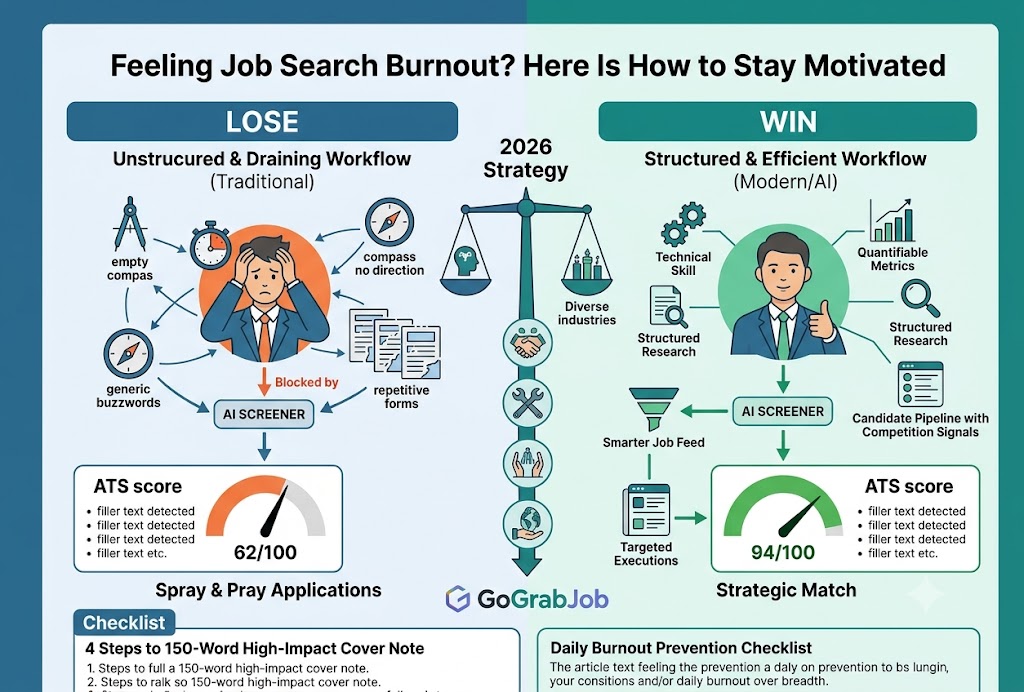
Understanding Job Search Burnout in Today's Competitive Market
Job search burnout is a very real, documented emotional and physical state characterized by chronic exhaustion, cynical feelings toward hiring processes, and a diminished sense of professional efficacy. In bustling hiring hubs across India and global tech centers—from Bengaluru and Hyderabad to London and San Francisco—job seekers face unprecedented competition. Sending dozens of tailored resumes into dark application portals without receiving a response creates a psychologically draining feedback loop. When you put hours of effort into custom cover letters and resume formatting only to encounter automated rejection templates, it is entirely natural for fatigue and doubt to creep in.
Part of why job search burnout hits so hard is decision fatigue mixed with context switching. Seekers spend hours jumping across multiple fragmented job portals, saving bookmarks, filling out repetitive form fields, and trying to decipher whether a opening is even actively hiring or already saturated. When you are forced to repeat these manual steps dozens of times every single week, your brain consumes vast amounts of executive energy on logistical overhead rather than actual career preparation. Over time, this leads to profound cognitive fatigue where even opening your laptop triggers anxiety.
Recognizing the early symptoms of job search fatigue is crucial before it severely damages your self-esteem and interview performance. Common signs include procrastinating on simple application tasks, feeling overwhelmed by interview invitations, constantly tweaking your background without direction, or feeling pervasive dread when reading job descriptions. To overcome this hurdle, you must realize that the modern job market cannot be conquered through brute-force volume alone. Spraying hundreds of generic resumes across different platforms only accelerates burnout without improving your callback rates. A fundamental shift toward targeted execution, smarter tools, and strict boundaries is essential to protect your energy while positioning yourself for meaningful success.
Practical Mental Strategies to Reclaim Momentum and Focus
To overcome job search exhaustion, you must treat your mental energy as a finite, precious resource. The first practical step is establishing hard boundaries around your job search activities. Spending eight continuous hours a day refreshing job boards creates an illusion of productivity while multiplying stress. Instead, cap your active job hunting to fixed, high-intent blocks—such as two structured hours every morning. Once that block finishes, close your job feeds and step away completely. Dedicate the remainder of your day to personal growth, physical movement, upskilling, or resting without guilt.
Another critical mindset shift is transitioning from outcome-based goals to process-based micro-wins. You cannot directly control whether a recruiter responds to your application today, but you can control the quality of your workflow. Shift your definition of daily success from 'getting an interview invite' to 'submitting two high-match, tailored applications with top-tier ATS scores.' By grounding your self-worth in repeatable, controllable actions, you protect your morale from the erratic timing of external hiring cycles.
Additionally, audit your application strategy to focus exclusively on quality match over sheer quantity. When you focus on roles that align precisely with your existing skill set, experience level, and preferred compensation structure (whether looking for ₹12 LPA tech roles in India or global remote positions), your response rates naturally improve. Higher conversion rates yield more positive reinforcement, breaking the vicious cycle of silent rejections. Cultivating a personal network, seeking peer feedback, and keeping an organized record of every submission also helps ground your search in reality, preventing that terrifying feeling that your efforts are dissolving into nothingness.
Stay Updated
Get the latest career insights and job search tips delivered to your inbox.
We'll only email you about new blog posts. Unsubscribe any time.
Streamlining Your Workflow with AI and Targeted Applications
Eliminating manual friction is one of the most effective ways to cure job search fatigue. Instead of juggling dozens of open browser tabs and spreadsheet rows, modern job seekers rely on unified AI workspaces like GoGrabJob to consolidate their entire candidate journey into one intelligent feed. By discovering opportunities from across multiple global platforms in a single, aggregated stream, you immediately eliminate hours of redundant search effort and tab switching.
Rather than blindly applying to every visible listing, intelligent matching algorithms evaluate your unique profile against open positions to assign ranked match scores. This ensures you spend your peak energy applying for roles where you possess a genuine competitive edge. Furthermore, clear applicant competition signals highlight when popular roles already have over 100 applicants. This real-time visibility prevents you from wasting valuable hours tailoring documents for saturated positions where your application might sit at the bottom of a massive stack.
When you do identify a target role, custom resume tuning capabilities instantly optimize your experience against the job description while displaying a live ATS score. Because GoGrabJob remembers every unique resume version tied to each specific application, you never have to guess which variation you sent when a hiring manager calls. Managing discovery, application customization, real-time tracking, and interview preparation within one centralized pipeline converts chaotic job hunting into a manageable, calm, and systematic routine.
Daily Burnout Prevention Checklist
Set a strict daily timer for job hunting (e.g., 90 to 120 minutes max).
Use a unified feed to discover ranked role matches instead of tab-hopping.
Check applicant competition signals before spending time on complex applications.
Tailor your resume to match the specific JD and verify your live ATS score.
Log every application in a centralized pipeline to eliminate mental clutter.
Step away completely after your daily block to exercise, rest, or upskill.
Frequently asked questions
How do I know if I am experiencing job search burnout?
Job search burnout typically presents as emotional exhaustion, persistent dread when opening job portals, irritability, loss of confidence, and a sudden drop in application quality. If you find yourself submitting generic resumes out of sheer fatigue or feeling overwhelmed by basic interview prep, you are likely suffering from job hunting burnout and should adjust your pacing immediately.
How many jobs should I apply for each day to avoid burnout?
Focusing on quality over volume is key. Applying to 2 to 4 highly relevant, thoroughly tailored roles per day yields significantly better conversion rates than submitting 30 generic applications. High-intent applications backed by tuned resumes and strong ATS scores dramatically reduce wasted effort and mental fatigue.
Can using an AI workspace really reduce job search fatigue?
Yes. An AI workspace eliminates repetitive overhead by aggregating multi-platform opportunities into a single feed, ranking jobs by profile fit, indicating applicant competition, and automatically tracking every application stage. By automating administrative tasks and resume tailoring, you spend less time on tedious work and keep your mental energy focused on interview success.
Run your job search in one workspace
Find roles ranked to your profile, tailor your existing resume for each job, score ATS fit, and track applications — free to start.