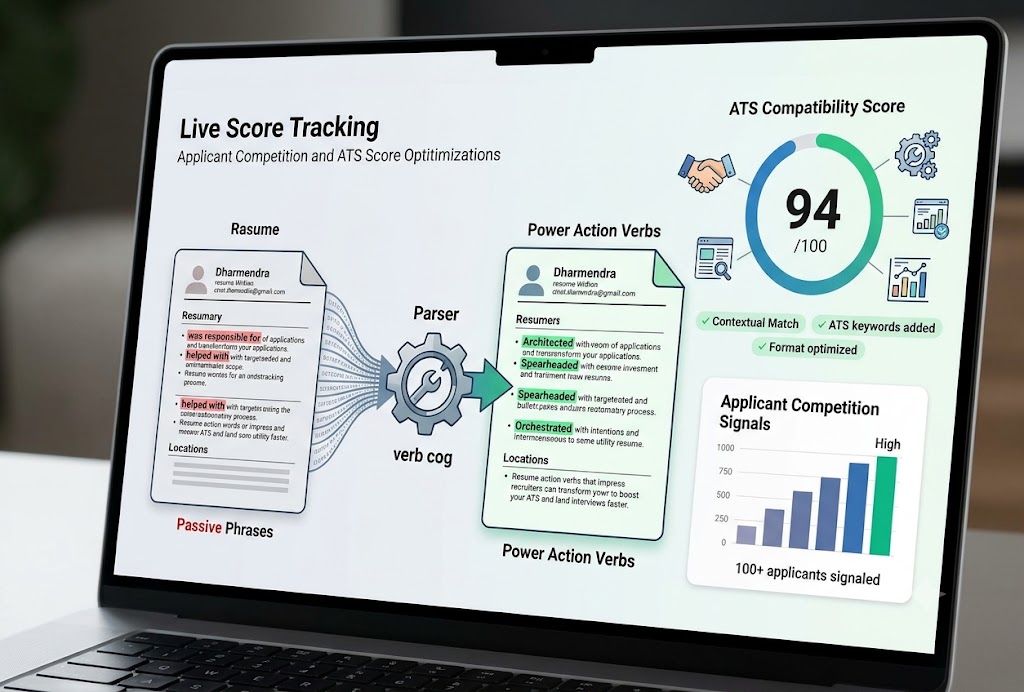
Why Resume Action Verbs Matter in Modern Recruitment
Recruiters and hiring managers spend an average of six to seven seconds on an initial resume scan. During this brief window, passive phrasing like 'assisted in,' 'duties included,' or 'worked on' fails to convey your actual contribution. Passive sentences make you sound like a passive participant in your career rather than an active driver of business results.
Using dynamic, high-impact action verbs completely changes how your qualifications are perceived. Instead of stating 'was responsible for client onboarding,' writing 'engineered an automated onboarding workflow that reduced client drop-off by 24%' immediately communicates leadership, execution capability, and tangible outcome. Strong action verbs serve as cognitive anchors for human reviewers, helping them instantly visualize your competence.
In high-volume job markets like India, technology hubs, and corporate sectors where single openings regularly attract over 100 applicants, standing out requires clear positioning. With automated screening and applicant competition signals indicating high applicant counts, every word on your resume must justify its place. Relying on energetic action verbs ensures that your experience reads with authority, setting a high standard before a human recruiter even completes their first scan.
High-Impact Action Verbs Categorized by Job Function
Choosing the right action verb depends heavily on the functional area and level of responsibility you wish to highlight. Overusing generic verbs like 'managed' or 'led' can make a resume sound repetitive. Diversifying your action words keeps the reader engaged while precisely detailing your expertise.
Leadership & Management Verbs
Instead of 'managed' or 'in charge of':
- Orchestrated: Demonstrates complex coordination across multiple moving parts or teams.
- Spearheaded: Highlights initiative in launching new programs, initiatives, or business units.
- Cultivated: Shows long-term investment in team development, client relationships, or strategic partnerships.
- Restructured: Signals organizational capability and high-level strategic alignment.
Engineering & Technical Verbs
Instead of 'coded,' 'built,' or 'worked on software':
- Architected: Refers to designing systems, infrastructure, or foundational software frameworks.
- Deployed: Highlights end-to-end execution and release management in production environments.
- Optimized: Focuses on performance improvements, latency reduction, or resource efficiency.
- Automated: Demonstrates modern engineering practices that reduce manual operational overhead.
Operations, Project Management & Execution Verbs
Instead of 'handled' or 'helped':
- Streamlined: Indicates process optimization, time savings, and operational cost reductions.
- Executed: Highlights dependable execution of complex plans within timeline and budget constraints.
- Consolidated: Shows efficiency gains by bringing disparate tasks or systems into a unified workflow.
- Standardized: Highlights compliance, quality control, and scalable process establishment.
Data, Finance & Analytical Verbs
Instead of 'looked at data' or 'did analysis':
- Evaluated: Reflects analytical rigor in assessing business cases, metrics, or risk factors.
- Forecasted: Shows strategic foresight in revenue modeling, demand planning, or budgeting.
- Quantified: Demonstrates data-backed decision making and clear measurement metrics.
- Audited: Highlights thoroughness, accuracy, and adherence to performance or compliance standards.
Quantifying Your Achievements: The Action Verb Formula
An action verb is most powerful when paired with measurable context. A common framework utilized by top talent teams is the Google X-Y-Z formula: Accomplished [X], as measured by [Y], by doing [Z]. Structuring your experience bullet points around this format ensures that your action verbs carry maximum weight.
For instance, consider the difference between these two entries:
- Weak/Passive: Responsible for managing digital marketing campaigns and posting on social media.
- Strong/Quantified: Spearheaded a multi-channel digital strategy that increased organic user acquisition by 42% over six months while reducing cost-per-lead by ₹1,500.
Notice how starting with 'Spearheaded' establishes immediate authority, followed by clear performance metrics (42% increase, ₹1,500 reduction) that prove success.
When writing your bullet points, ask yourself three questions for every role:
- What exact action did I take? (Select your power verb)
- What was the direct output or metric of that action? (Percentages, revenue, time saved, user growth)
- What tools, techniques, or strategy made it possible?
By consistently combining strong verbs with concrete numbers, you transform a list of past duties into a compelling portfolio of professional achievements.
Stay Updated
Get the latest career insights and job search tips delivered to your inbox.
We'll only email you about new blog posts. Unsubscribe any time.
Optimizing Verbs for ATS Match Scores and Tailored Applications
Modern recruitment relies heavily on Applicant Tracking Systems (ATS) to filter and rank resumes before a recruiter ever reviews them. ATS software parses your resume for specific keywords, skill phrases, and action verbs directly mentioned in the target job description. If a company's job posting emphasizes 'orchestrated cross-functional teams' or 'designed microservices,' using those exact dynamic verbs signals strong context alignment to the parsing engine.
However, manually altering your resume for every single job opening can quickly lead to document clutter and confusion over which version was sent where. Using an integrated application workspace allows you to generate a JD-tuned resume tailored to every specific role while receiving a live ATS match score before submitting.
Furthermore, keeping a complete record of every resume version per application ensures you know precisely which action verbs and metrics were presented when invited for an interview. Combining tailored action verbs with real-time score feedback ensures your resume consistently ranks high in automated screening systems and resonates with human recruiters alike.
Frequently asked questions
What are the best action verbs to use on a resume?
The best action verbs are specific, high-impact words tailored to your career field. High-performing options include 'spearheaded,' 'architected,' 'orchestrated,' 'streamlined,' 'quantified,' and 'evaluated.' Avoid overused, passive terms like 'responsible for' or 'helped with.'
How many action verbs should I include per bullet point?
Every bullet point in your work experience section should start with exactly one strong action verb. Avoid stacking multiple verbs in one sentence, as it can confuse the reader and weaken the impact of your core accomplishment.
Can using strong action verbs improve my resume's ATS score?
Yes. Modern Applicant Tracking Systems parse resume bullet points for contextual keywords and action phrases present in the job description. Using strong verbs that mirror the job requirements increases keyword density and context matching, resulting in a higher overall ATS match score.
Run your job search in one workspace
Find roles ranked to your profile, tailor your existing resume for each job, score ATS fit, and track applications — free to start.