The Limitations of Standalone Resume Builders in Modern Hiring
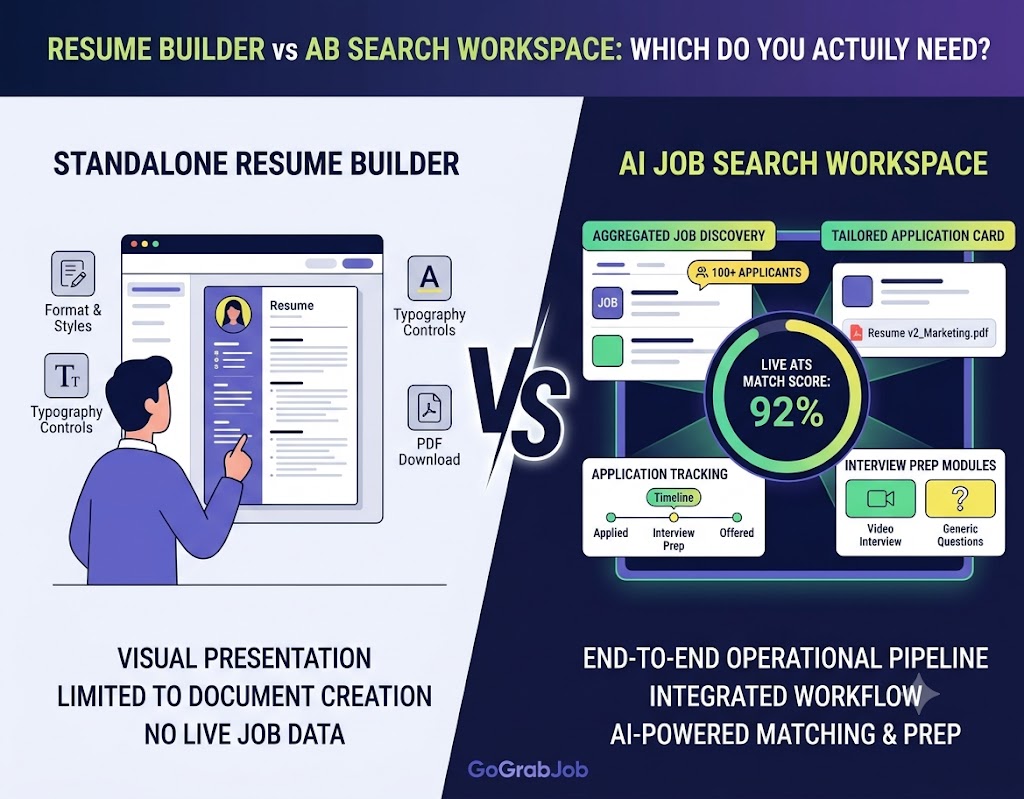
Standalone resume builders originally emerged to replace outdated desktop word processors. They excel at visual presentation, providing clean layout formatting, typography controls, and convenient PDF downloads. However, in today's rapidly evolving recruitment landscape—especially across high-density talent markets like India—having a visually polished resume covers only a fraction of what a successful job search requires. Once you export a document from a traditional resume builder, your digital workflow stops cold.
After downloading a PDF, job seekers are left to navigate scattered job portals independently, copy and paste separate job descriptions into local folders, and guess whether their document will successfully clear an Automated Applicant Tracking System (ATS). Standalone resume tools operate in a vacuum. They cannot evaluate your resume against live job listings, nor do they offer dynamic feedback regarding missing keywords or technical proficiencies required for specific positions.
This disconnected process leads to organizational fatigue. Candidates often end up managing dozens of local document files labeled "Resume_v1_Tech.pdf" or "Resume_Final_Marketing.pdf" across their hard drives, quickly losing track of which resume variation was submitted to which company. When a recruiter schedules a sudden screening call, job seekers must search through old folders just to recall what specific skills they emphasized. In hyper-competitive job markets where popular open roles regularly attract over 100 applicants within hours of posting, relying solely on cosmetic resume editing creates operational friction, disorganization, and delayed response times.
What Is an AI Job Search Workspace?
An AI job search workspace fundamentally redefines job hunting by shifting focus from isolated task completion to an end-to-end operational pipeline. Instead of handling job discovery, document customization, application tracking, and interview preparation as separate, fragmented chores, an integrated workspace unifies every stage of the search into one central platform.
The process begins with aggregated job discovery. Rather than manually scanning multiple job boards and portal tabs every morning, an AI job search workspace consolidates opportunities from across platforms into a single ranked feed. Using profile-matching intelligence, the feed highlights roles that align with your background rather than forcing you to sift through irrelevant listings. When competition data is available, applicant volume signals warn you if a posting already has heavy traction—such as 100+ existing applicants—helping you prioritize fresh roles where your response rate is statistically stronger.
Beyond simple discovery, an AI workspace directly bridges the gap between job requirements and your application documents. It presents job-description-tuned resume suggestions and computes a live ATS match score per application, ensuring your experience aligns with specific role requirements before you submit. Crucially, the workspace retains full document version memory, automatically saving every tailored resume variation under its corresponding application card. Once applied, your progress seamlessly transitions into a organized tracking pipeline equipped with structured interview preparation tailored to that exact role description. Available across global markets in English, Spanish, Portuguese, and Russian, an AI job search workspace turns a chaotic job hunt into a structured, repeatable strategy.
Head-to-Head Comparison: Builder vs Workspace
Understanding the functional differences between traditional resume builders and comprehensive AI workspaces helps clarify why job seekers are shifting toward integrated tools. Here is how both approaches compare across key stages of the modern job search:
-
Job Discovery & Recommendations: Traditional resume builders offer no discovery features. You must manually search external job boards and track openings yourself. An AI job search workspace aggregates postings into a unified feed, ranking opportunities according to your profile match and displaying applicant competition signals.
-
ATS Optimization & Tailoring: Resume builders offer fixed visual templates with generic phrase suggestions. An AI workspace dynamically compares your profile against a specific job description, calculating a real-time live ATS score and guiding precise edits for each targeted application.
-
Document & Version Management: Traditional tools require manual file saving, leading to cluttered desktops and confusion regarding submitted documents. An AI workspace automatically archives every customized resume version directly inside the job's application tracking card.
-
Application Pipeline & Interview Prep: Standalone resume software ends its utility as soon as a document is exported. An AI workspace guides you through application pipeline tracking, stage updates, and automated interview preparation based on the job description.
In competitive employment sectors—such as tech, finance, and product management in India's major hiring hubs like Bengaluru, Mumbai, and NCR—speed and tailored execution are paramount. Relying on isolated document tools introduces avoidable delays, whereas an integrated workspace maintains continuous momentum across every stage.
Stay Updated
Get the latest career insights and job search tips delivered to your inbox.
We'll only email you about new blog posts. Unsubscribe any time.
Core Differences at a Glance
Standalone Builders: Focus strictly on visual PDF creation without live job data integration.
AI Workspaces: Combine multi-platform job discovery into a single ranked, personalized feed.
Standalone Builders: Require manual file storage and offline version tracking per job application.
AI Workspaces: Provide live ATS match scoring and store unique resume versions per application automatically.
Standalone Builders: Stop assisting you once the resume file is downloaded to your computer.
AI Workspaces: Offer end-to-end tracking pipelines and JD-derived interview preparation tools.
Optimizing Your Career Pipeline with a Workspace Workflow
Transitioning from a basic resume builder to an AI job search workspace requires adopting a strategic mindset focused on application quality and pipeline management. Instead of treating job applications as disconnected tasks, structure your daily routine around a continuous, streamlined workflow.
Start your morning by reviewing your unified ranked feed. Focus on opportunities with high match scores where applicant competition is still low or manageable. When selecting a target job, review the live ATS match score provided by the workspace. Use the AI tuning suggestions to refine your accomplishment bullet points, aligning key technical terms and responsibilities directly with the job description parameters without exaggerating your experience.
Once your customized resume is complete and submitted, track the application within your pipeline. Because the workspace remembers every exact resume iteration for every role, you can immediately review your tailored document seconds before speaking with a recruiter or hiring manager. Finally, launch integrated interview preparation modules to practice answering technical and behavioral questions curated directly from the target job description. While no platform can guarantee interviews or eliminate competition on high-demand postings, operating inside an integrated workspace ensures that every application you send is precise, organized, and competitive.
Frequently asked questions
Is a free standalone resume builder enough to land a job?
While a basic resume builder helps format a visual PDF, it leaves you to handle job discovery, ATS keyword matching, version control, and application tracking manually. In competitive hiring markets, an integrated AI workspace gives you a structural advantage by linking your resume optimization directly to live job descriptions and application tracking pipelines.
How does an AI job search workspace calculate my ATS score?
An AI job search workspace compares your resume text directly against the specific job description you select. It analyzes required skills, technical keywords, experience level, and contextual phrases to generate a real-time live ATS score, highlighting concrete areas where you can strengthen alignment before submitting.
Can an AI workspace guarantee that I land job interviews?
No platform can guarantee job interviews or remove applicant competition on popular roles. An AI job search workspace helps you discover relevant positions faster, prioritize strong profile matches, optimize resume quality with live ATS scores, and stay fully prepared for recruiter interviews.
Run your job search in one workspace
Find roles ranked to your profile, tailor your existing resume for each job, score ATS fit, and track applications — free to start.