What Is a Resume Job Description Match Score?
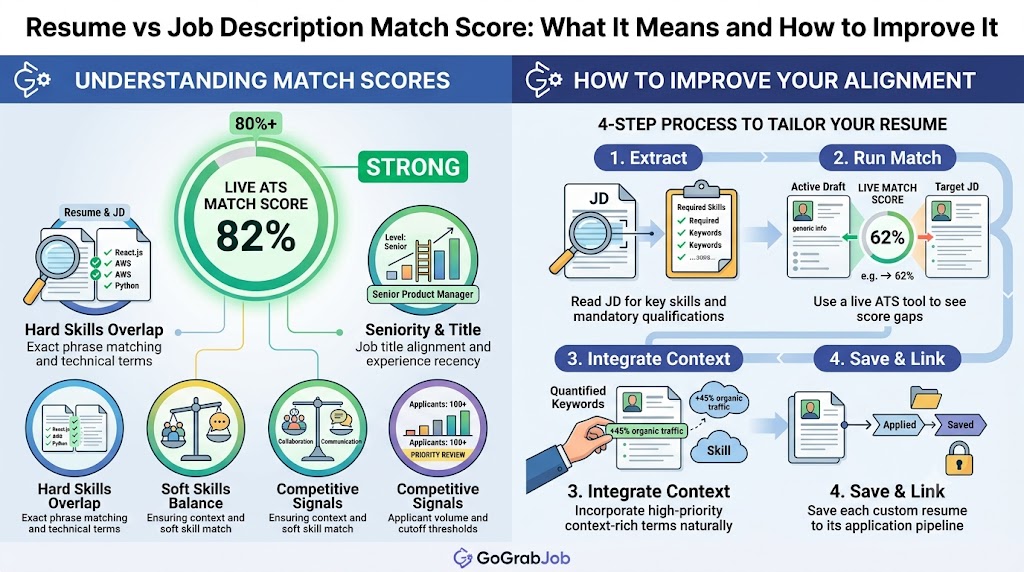
A resume job description match score is a numerical percentage that measures how closely the contents of your resume align with the specific requirements, skills, and qualifications listed in a job posting. Modern Applicant Tracking Systems (ATS) and job search workspaces utilize natural language processing (NLP) to parse your document and evaluate context, hard skills, soft skills, job titles, and educational background against the recruiter's ideal candidate profile.
In hyper-competitive employment hubs across India—such as Bengaluru, Gurugram, Hyderabad, and Mumbai—as well as top international remote markets, hiring managers routinely receive hundreds of applications for a single vacancy. To manage this influx, automated screeners analyze candidate submissions and generate a live match score. Applications with higher relevance scores are prioritized at the top of the recruiter's dashboard, while lower-scoring resumes run the risk of getting lost in database archives.
It is vital to maintain realistic expectations regarding these automated scores. Achieving a high match score does not magically guarantee an instant interview offer, nor does it eliminate competition. However, understanding and optimizing your score ensures that your application passes automated filtering systems cleanly, placing your qualifications directly in front of human decision-makers. Utilizing tools like GoGrabJob allows job seekers to analyze live ATS match scores and tune their resumes to specific job descriptions in real time.
How ATS Algorithms Calculate Match Scores
To systematically improve your alignment score, you must understand how applicant screening software processes your uploaded resume. Algorithms break down both the job description (JD) and your resume into structured datasets, cross-referencing specific metrics to compute a cumulative compatibility grade.
1. Keyword Overlap and Exact String Matching
The primary layer of match calculation relies on identifying hard keywords. If a position demands React.js, TypeScript, and GraphQL, the system checks whether these exact phrases exist within your employment history or skills sections. Missing high-priority terms heavily penalizes your total score.
2. Semantic Context and Related Terminology
Modern screening engines go beyond literal keyword matching. They utilize semantic algorithms to identify related concepts. For example, if a job description emphasizes People Management, the system recognizes related terms like Team Leadership, Direct Reports, or Resource Allocation. However, relying solely on synonyms can lead to lower confidence scores compared to using the exact phrase found in the JD.
3. Experience and Title Hierarchy
Algorithms examine recency and job title hierarchy. A skill demonstrated in your most recent role carries more weight than one listed in an entry-level position from seven years ago. Furthermore, having exact or closely related past job titles (e.g., Senior Product Marketing Manager matching Senior Product Marketing Manager) significantly boosts structural alignment.
4. Applicant Competition Signals
When popular job listings attract 100+ applicants within hours of posting, ATS algorithms apply stricter cutoff thresholds. In high-demand roles, candidates with a 60% match score may be filtered out automatically, whereas candidates maintaining an 80%+ score gain immediate recruiter review. Monitoring applicant volume signals helps you prioritize roles where your tailored resume stands out best.
Key Factors That Drive a Higher ATS Match
Boosting your resume job description match score requires a balanced approach that combines structural clarity, strategic keyword integration, and contextual proof of accomplishments. Simply copying and pasting the job description into your resume—or using unethical tricks like white-text keyword stuffing—will result in immediate rejection by human recruiters.
Clean Document Structure and Standard Headings
ATS parsers rely on recognized section headers to accurately categorize your experience. Use standard section titles such as Professional Experience, Technical Skills, Education, and Certifications. Non-standard headings like Where I've Been or My Milestones confuse automated tools, leading to unparsed sections and artificially low match scores.
Balanced Hard and Soft Skills Distribution
Ensure your resume balances core technical competencies (e.g., Data Analysis, AWS, Financial Modeling) with essential soft skills (e.g., Cross-Functional Collaboration, Stakeholder Management). Review the job description to determine which skills are referenced most frequently and mirror that balance in your key summary and experience bullet points.
Quantifiable Impact and Context
Keywords must exist within meaningful accomplishment statements. Rather than simply listing SEO Optimization as a bullet item under skills, write: 'Executed comprehensive SEO optimization strategies that increased organic traffic by 45% over six months.' Contextual usage validates to both the algorithm and the recruiter that you possess practical experience.
Managing Resume Versions Per Application
Tailoring your resume for every single job application can easily create organizational confusion. Storing every resume version linked directly to its specific job application—within a unified workspace pipeline like GoGrabJob—ensures you retain exact visibility into what you submitted when an employer calls for an interview.
Stay Updated
Get the latest career insights and job search tips delivered to your inbox.
We'll only email you about new blog posts. Unsubscribe any time.
4-Step Process to Tailor Your Resume for ATS
- 1
Extract High-Frequency Keywords from the JD
Read the target job description carefully and isolate mandatory technical skills, required tools, certs, and key core responsibilities.
- 2
Run a Live Resume Match Comparison
Compare your active resume draft against the target job description using a live ATS score tool to highlight missing skills and gaps.
- 3
Integrate Contextual Terms into Your Bullet Points
Incorporate missing high-priority keywords naturally into your professional work history with quantified bullet points.
- 4
Save the Tailored Version to Your Pipeline
Log the updated resume version under the specific application pipeline stage to keep your active tracking organized and interview-ready.
Actionable Tactics to Optimize Your Resume Alignment
To achieve consistently high resume job description match scores across your job search, establish a streamlined workflow that connects job discovery with application tracking. Haphazardly blasting out generic resumes yields low response rates, especially when competing against hundreds of candidates in major corporate centers.
First, start by discovering relevant opportunities from multiple platforms aggregated into one ranked unified feed. By identifying jobs tailored to your existing baseline skills, you begin the application process with a higher natural match score.
Second, refine your bullet points specifically for top-tier targets. If a company values Agile Delivery, update your existing project management descriptions to explicitly mention Agile methodologies, sprint planning, and daily standups. Always verify that your resume remains simple, clean, and free of complex tables, graphic elements, or text boxes that disrupt ATS parsing software.
Finally, maintain a single pipeline to discover, apply, track, and prep for interviews. When your tailored resume successfully passes the ATS and triggers a recruiter call, having instant access to the exact version you submitted—alongside integrated interview prep tools—ensures you articulate your qualifications with complete confidence.
Resume Job Description Match Audit Checklist
Job title on resume closely reflects the target job post title
Top 5 hard technical skills from the JD are present in your skills section
Key qualifications are integrated directly into work experience bullet points
Document uses clean standard headers (Experience, Education, Skills)
File format is an ATS-friendly .docx or standard searchable PDF
Graphics, tables, icons, and non-standard fonts have been removed
Tailored resume version is saved and linked to your tracking pipeline
Frequently asked questions
What is a good resume job description match score?
Generally, an ATS match score of 75% or higher is considered strong. It indicates that your resume aligns with the vast majority of core skills, titles, and qualifications demanded by the employer. Scoring above 80% places your application among the top tier of candidates in automated screening systems.
Can a high match score guarantee a job interview?
No tool or service can guarantee job interviews or remove competition on hot roles. A high resume job description match score ensures your application passes automated screening filters and is ranked favorably for human review. Final interview decisions depend on recruiter evaluation, portfolio quality, and candidate fit.
Why should I save different resume versions for each application?
Tailoring your resume means adjusting language for different roles. Saving each custom resume version per application ensures you know precisely what information, skills, and metrics the hiring manager reviewed when they reach out to schedule an interview.
Run your job search in one workspace
Find roles ranked to your profile, tailor your existing resume for each job, score ATS fit, and track applications — free to start.