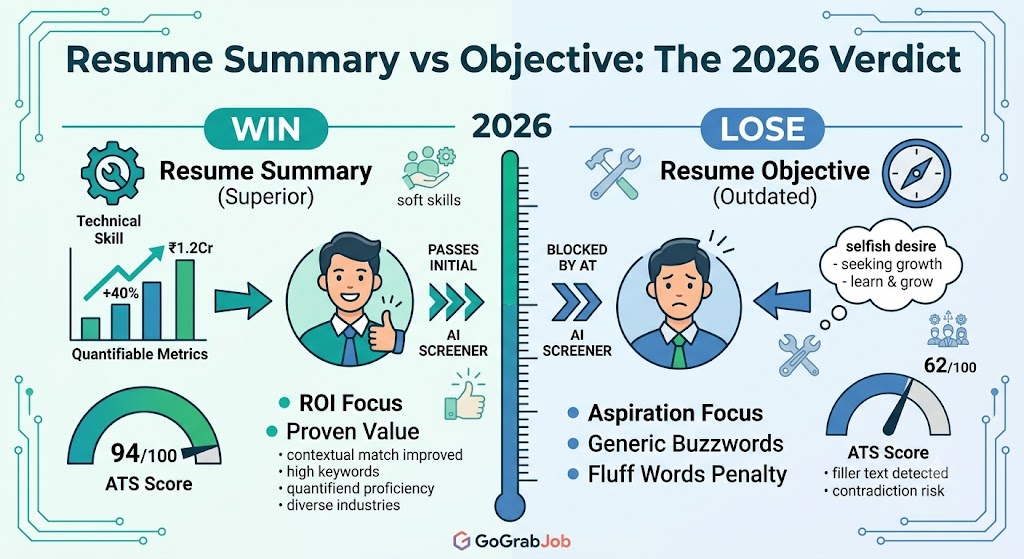
Understanding the Core Differences Between a Resume Summary and Objective
When launching a job search across competitive markets—whether in major Indian tech hubs like Bengaluru and Gurugram or global remote ecosystems—the top top 10% of your resume decides your fate. Recruiters spend an average of six seconds scanning an application before making an initial shortlist decision. Your opening statement serves as the hook, but job seekers frequently confuse two distinct formats: the resume summary and the resume objective.
A resume summary (or professional summary) is a concise 3-to-4 line snapshot of your most impressive professional achievements, core technical competencies, and quantifiable business impact. It is framed entirely around what you bring to the employer's table. For example, rather than stating you are looking for a role, a summary highlights that you managed a ₹1.2 Crore cloud migration project or boosted software delivery speed by 40%. It demonstrates proven value immediately, assuring the hiring manager that you hold the exact credentials required for the position.
In contrast, a resume objective focuses on your career aspirations, personal goals, and what you hope to gain from the hiring organization. Written traditionally as a 1-to-2 line declaration, an objective statement outlines your enthusiasm and educational background, aiming to convey potential rather than historical output. An example might state: 'Motivated computer science graduate seeking an entry-level software engineer role at a fast-growing tech firm to develop skills in full-stack development.'
While both statements sit at the top of your resume right beneath your contact details, their strategic functions diverge dramatically. Modern talent acquisition workflows rely heavily on algorithmic screening engines, making the structural choice between these two openers critical to passing automated initial filters.
Resume Summary vs Objective: Which Should You Use in 2026?
If you are asking yourself resume summary vs objective which is better, the definitive answer for 2026 is that the resume summary is superior for over 90% of job seekers. Modern talent acquisition teams prioritized candidate ROI and instant alignment. Employers are scanning profiles to solve specific organizational challenges, and a well-crafted professional summary instantly communicates how you solve those problems.
However, there are specific scenario-based exceptions where an objective statement—or a hybrid approach—remains practical. Understanding where you sit in your professional journey dictates the optimal choice:
1. Experienced Professionals & Mid-Career Growth (Use a Summary)
If you have two or more years of domain experience, an objective statement actually degrades your application. Claiming you want to 'learn and grow in a dynamic team' signals a beginner mindset. Instead, use a metric-dense resume summary that mirrors the job description (JD). Highlight key achievements, tech stacks, or revenue impacts that directly match the role's primary requirements.
2. Recent Graduates & Freshers (Use an Objective or Hybrid Statement)
For fresh graduates across campuses in India or international universities, proving three years of full-time metrics isn't always possible. In this scenario, an objective statement is acceptable—provided it emphasizes relevant coursework, academic projects, internships, and soft skills rather than purely selfish desires. A hybrid 'Career Focus Summary' often works best here: combine your top academic accomplishment with a clear statement of how your specific skills align with the employer's needs.
3. Career Changers & Industry Pivoters (Use a Tailored Summary)
When switching industries—for instance, moving from traditional banking into fintech or customer support into tech product management—a standard resume summary might confuse recruiters. However, an objective isn't the right fix either. Instead, leverage a pivoting summary that frames your transferable skills. Frame your past leadership, analytical capability, or project management methodologies around the target industry's pain points.
At GoGrabJob, our AI job search workspace helps you analyze individual job descriptions to determine which functional skills and metrics belong in your top header, ensuring your resume speaks directly to the employer's prioritized keywords.
Quick Comparison Checklist
Resume Summary: Focuses on employer ROI and past measurable achievements.
Resume Objective: Focuses on applicant career goals and learning aspirations.
Resume Summary: Best for mid-level professionals, senior leads, and specialists.
Resume Objective: Acceptable for entry-level freshers and new graduates.
Resume Summary: High density of hard industry keywords for ATS parsing.
Resume Objective: Lower keyword density, requiring careful tuning for ATS compatibility.
How ATS Algorithms Evaluate Your Resume Header
Modern hiring infrastructure relies on applicant screening software to organize thousands of candidate profiles. When popular job roles frequently attract hundreds of applicants within hours of posting, automated systems parse text headers long before a recruiter opens your file.
From a technical perspective, applicant tracking systems scan your resume top-to-bottom, identifying contextual clusters of keywords. A resume summary acts as a high-density keyword reservoir. Because it combines job titles, tools, frameworks, and domain-specific methodologies in a concise paragraph, the ATS parser immediately assigns a higher initial contextual relevance score to your application.
Conversely, traditional objective statements are notorious for containing fluff words like 'hardworking,' 'passionate,' or 'seeking growth.' These buzzwords carry zero weight in modern semantic match engines. An candidate with an objective statement that lacks hard skills runs the risk of getting filtered out, even if their lower work experience section contains the right technical background.
To overcome this hurdle, job seekers need real-time feedback on their applications. Using GoGrabJob’s workspace, candidates can compare their resume draft against specific job descriptions to receive a live ATS match score. The platform pinpoints missing keywords and allows you to tune your summary directly for that specific vacancy. Furthermore, because GoGrabJob maintains a dedicated application pipeline, every tailored resume version is remembered automatically per application—enabling you to track discover, apply, track, and interview prep stages seamlessly without losing track of your customized headers.
Stay Updated
Get the latest career insights and job search tips delivered to your inbox.
We'll only email you about new blog posts. Unsubscribe any time.
4 Steps to Craft an ATS-Optimized Resume Header
- 1
Extract Core Keywords from the Job Description
Analyze the target posting for mandatory skills, required toolsets, and key responsibilities (e.g., React.js, Agile, Budgeting).
- 2
Lead with Your Professional Title & Years of Experience
Begin your summary with a strong descriptor, such as 'Senior Frontend Developer with 5+ years of experience building scalable web applications...'
- 3
Quantify Impact with Concrete Numbers and Metrics
Include percentage improvements, team sizes, project values, or efficiency gains (e.g., 'reduced API response times by 35%').
- 4
Check Your Live Match Score Before Submitting
Run your resume through a live ATS scoring panel to ensure all primary skills are captured in the top third of your resume document.
Step-by-Step: Crafting a High-Scoring Summary for Modern Platforms
Writing an engaging resume summary does not require complex creative writing; it requires clarity, structure, and targeted precision. A reliable, high-converting formula follows a 3-sentence structure:
- Sentence 1: Professional Identity & Core Expertise – Frame who you are and your years of domain experience aligned with the target role.
- Sentence 2: Highlight Achievement & Hard Skills – Call out 2–3 key technical tools, domain methodologies, or quantifiable achievements.
- Sentence 3: Value Add Statement – State how you intend to drive results or solve problems for the prospective employer.
Example 1: Software Engineer Summary (Experienced)
'Results-driven Full Stack Engineer with 4+ years of experience designing cloud-native microservices in Node.js and AWS. Proven track record of optimizing database performance, reducing latency by 45% across high-traffic fintech applications. Seeking to leverage deep backend expertise to scale robust infrastructure at [Company Name].'
Example 2: Digital Marketing Specialist (Mid-Career)
*'Data-focused Performance Marketer with 3 years managing end-to-end paid acquisition channels with monthly budgets exceeding ₹10 Lakhs. Specialized in search engine marketing, conversion rate optimization, and funnel analytics that delivered a 28% decrease in customer acquisition cost (CAC).'
Example 3: Computer Science Graduate (Fresher Objective/Hybrid)
'Detail-oriented Computer Science graduate with hands-on experience building mobile applications using Flutter and Python. Developed a peer-to-peer delivery app as a final-year project, achieving a 98% user satisfaction rating in campus testing. Eager to apply algorithmic problem-solving skills to entry-level software engineering challenges.'
When managing your job application pipeline on GoGrabJob, you can organize your discovery feeds from global and Indian roles in one unified place. Instead of generic applications, matching your summary statement specifically to each target position gives you a structured, quality-first approach to standing out in crowded applicant pools.
Frequently asked questions
Is a resume summary or objective better for a candidate with no experience?
For freshers or entry-level candidates with limited formal work experience, a hybrid resume objective or 'Career Focus Summary' is better. Rather than stating what you want from the company, highlight academic projects, technical proficiencies, internships, and relevant certifications alongside your short-term career goals.
How long should a resume summary statement be in 2026?
A high-performing resume summary should be concise—ideally between 3 to 4 lines or approximately 40 to 60 words. It should be written in active bullet points or a tightly edited short paragraph placed directly underneath your contact header section.
Can having an outdated objective statement hurt my ATS score?
Yes. Automated Applicant Tracking Systems (ATS) score profiles based on relevant keyword matches and semantic context. Outdated objectives filled with generic phrases like 'seeking a challenging position' add no keyword value and dilute the overall keyword density of your resume, potentially lowering your overall match rank.
Run your job search in one workspace
Find roles ranked to your profile, tailor your existing resume for each job, score ATS fit, and track applications — free to start.