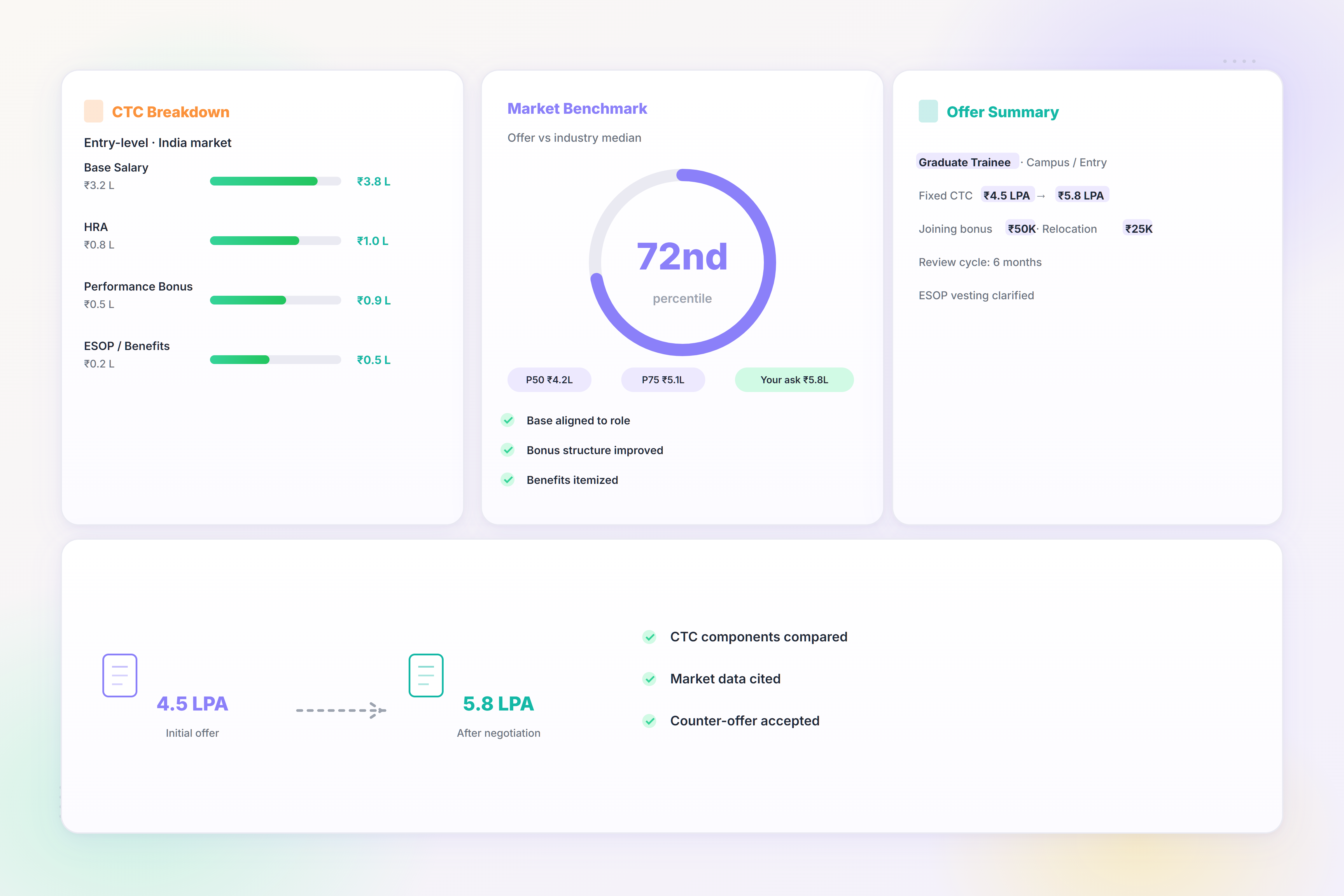
Understanding CTC vs Take-Home Salary in India
For entry-level job seekers in India, receiving a first job offer letter is an exciting milestone. However, confusion often arises when looking at the distinction between the total Cost to Company (CTC) figure and the actual monthly take-home amount that hits your bank account. Companies in India structure compensation packages using various components, including basic salary, House Rent Allowance (HRA), special allowances, employer contributions to the Employee Provident Fund (EPF), gratuity, health insurance premiums, and performance-linked incentives.
A fresher offered an 8 LPA (Lakhs Per Annum) package might expect a monthly salary of roughly ₹66,000. In reality, once mandatory deductions, statutory benefits, and variable bonuses are factored out, the actual monthly take-home pay might hover between ₹48,000 and ₹52,000. Understanding these underlying layers is the essential first step before attempting any negotiation.
When evaluating an offer, separate the fixed pay from the variable components. Fixed pay represents your guaranteed monthly income, whereas variable pay is contingent on personal or company performance metrics. Employers also include statutory benefits like gratuity and provident fund contributions in the macro CTC number, which are long-term retiral benefits rather than liquid monthly cash flow. Knowing exactly how these line items are split provides the clarity needed to ask targeted questions during pay discussions.
Benchmarking Market Value with Match Signals
Negotiating effectively requires a clear understanding of the broader market standards for your specific role, technology stack, and geographic location. Compensation bands across Indian tier-1 tech hubs such as Bengaluru, Hyderabad, Pune, and Delhi NCR vary significantly compared to tier-2 cities. Rather than relying on generic guesses or anecdotal advice, freshers should gather reliable benchmark data across multiple sources.
Modern job search workflows help streamline this process by aggregating open roles into a unified feed ranked by profile fit. By exploring matched listings across different industries, you can gain a realistic perspective on average entry-level salary ranges for positions like Software Development Engineer, Data Analyst, or Product Associate. Pay attention to applicant competition signals when reviewing roles; popular openings may quickly accumulate over 100 applicants, which alters the leverage dynamic compared to specialized roles with lower candidate volume.
Evaluating how closely your credentials align with job descriptions provides a strong foundation for your target salary range. When your background achieves a high match score against role requirements, you enter discussions with validated proof of alignment, helping you justify why your application warrants a compensation figure at the upper end of the benchmarked pay band.
Key Steps to Negotiate Your Entry-Level Salary
- 1
Analyze the Offer Breakdown
Request a complete line-item breakdown of the CTC, distinguishing fixed pay, variable incentives, joining bonuses, and statutory deductions.
- 2
Benchmark Against Profile Alignment
Cross-reference the offered figures with industry standards for your skill set and geographic location, using live match insights to assess your fit.
- 3
Highlight Tailored Resume Evidence
Reference specific project outcomes, certifications, and technical skills highlighted in your JD-tuned resume to demonstrate immediate value.
- 4
Frame the Counter-Proposal Professionally
Communicate your requested adjustment respectfully via email or call, tying the request directly to market benchmarks and qualified credentials.
Tactics for Entry-Level Salary Negotiation
Many freshers hesitate to negotiate, worrying that expressing a desire for higher pay might lead to a rescinded offer. In reality, most talent acquisition teams expect a reasonable, professional discussion regarding compensation, provided it is backed by sound reasoning rather than arbitrary demands. The key lies in framing your request around demonstrated capability and market facts.
When presenting your case, connect your requested adjustments directly to the requirements outlined in the job description. If you used a JD-tuned resume that aligns your project work, internship experience, and technical certifications with the company's stack, use those exact proof points in your conversation. Emphasize how your background enables you to contribute quickly with minimal training overhead.
Always maintain a polite, enthusiastic tone throughout the process. A helpful phrase to use is: 'I am thrilled about the prospect of joining the team and contributing to [Project/Team Name]. Based on my hands-on experience with [Key Skill] and market benchmarks for this role in [City], I was hoping we could review the fixed component closer to [Target Figure].' If the recruiter indicates that base salaries are rigid for fresher cohorts, you can pivot the discussion toward variable components or one-time benefits.
Stay Updated
Get the latest career insights and job search tips delivered to your inbox.
We'll only email you about new blog posts. Unsubscribe any time.
Fresher Offer Evaluation Checklist
Fixed base pay meets minimum monthly financial requirements
Variable pay criteria and payout timelines are clearly defined
Relocation allowance or initial lodging assistance is provided if moving cities
Joining bonus or tenure-based retention bonus is documented
Service agreements, bonds, or notice period clauses are thoroughly reviewed
Evaluating Non-Monetary Perks and Perks Beyond Base Pay
When an employer operates within strict fresher salary bands that prevent adjustments to fixed base pay, non-monetary perks and supplementary benefits become valuable negotiation targets. In many cases, HR departments have greater flexibility with discretionary budgets like joining bonuses, learning allowances, or remote work stipends than with core salary tables.
Consider requesting a one-time joining bonus or relocation assistance if you are moving to a new tech hub. Alternatively, discuss professional development benefits, such as company-sponsored technical certifications, conference attendance, or tuition reimbursement programs. These benefits enhance your long-term career growth and earning potential even if the immediate fixed salary remains unchanged.
Additionally, pay close attention to structural contractual conditions, such as employment bonds, service agreements, or lengthy notice periods. A lower salary accompanied by a multi-year service bond represents a significant restriction on future mobility. Organise all your active job opportunities within a single application tracking pipeline so you can evaluate total compensation, growth potential, and employment conditions across multiple potential offers simultaneously before signing.
Frequently asked questions
Can freshers in India negotiate their starting salary?
Yes, freshers in India can negotiate their starting salary, provided they approach the conversation professionally and base their request on market standards, specialized skills, or internship achievements. While large corporate campus hires often have standardized pay bands, mid-sized firms, startups, and specialized technical roles frequently offer room for discussion on base pay, joining bonuses, or relocation stipends.
What key items should I examine in my fresher CTC letter?
When reviewing a CTC letter, carefully separate the fixed basic salary from variable components, performance bonuses, joining incentives, and statutory deductions like Provident Fund (PF) and professional tax. Look closely for non-cash perks, health insurance coverages, and potential employment bond terms or notice period requirements to understand your actual net take-home pay.
How does tailoring my resume help in compensation discussions?
Tailoring your resume to match specific job descriptions ensures that your core skills, relevant project work, and internship accomplishments are clearly presented. Achieving a high ATS score demonstrates strong alignment with the role's requirements, giving you clear evidence of fit when discussing competitive compensation bands with hiring managers.
Run your job search in one workspace
Find roles ranked to your profile, tailor your existing resume for each job, score ATS fit, and track applications — free to start.