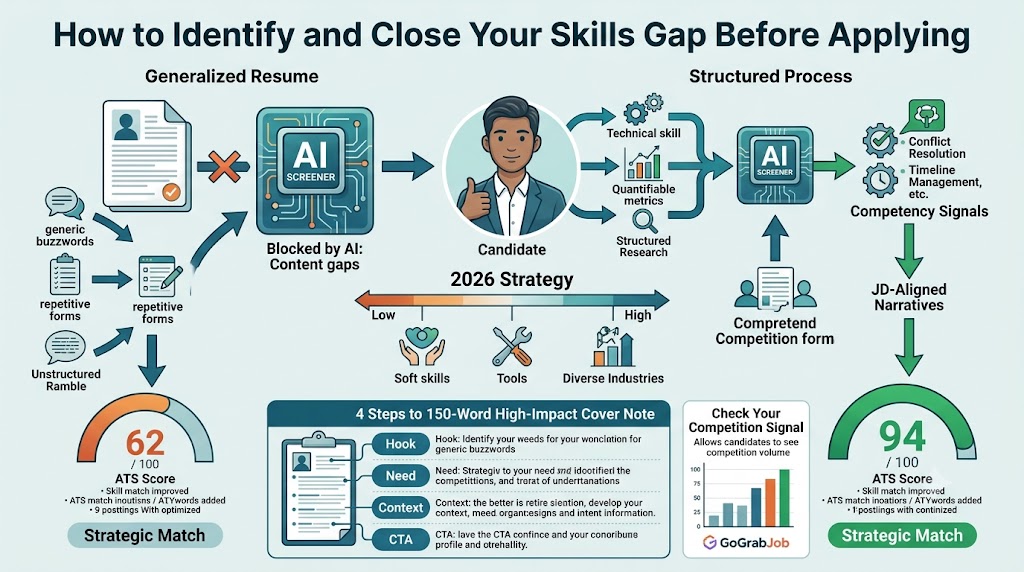
What is a Skills Gap Analysis for Job Seekers?
A skills gap analysis for job seekers is a systematic evaluation of the qualifications, technical expertise, and core competencies you currently possess compared against the specific requirements listed in target job descriptions. In today's dynamic employment market—spanning competitive hubs across India, North America, Europe, and LATAM—employers rely heavily on automated screening systems to filter out applicants who fail to demonstrate exact keyword alignment. Conducting a thorough self-audit allows you to pinpoint missing proficiencies before submitting your application, saving you time and preventing instant rejections by Applicant Tracking Systems (ATS).
When candidates struggle to land interview callbacks despite submitting hundreds of applications, the root cause is rarely a lack of talent; rather, it is a mismatch between how their credentials are represented and what hiring managers are explicitly demanding. Popular job openings across top platforms routinely attract 100 or more applicants within hours of being posted. In such crowded applicant pools, candidates who submit generalized resumes are quickly outranked by those who have mapped their existing experience directly to the required job description.
Performing a structured skills audit transforms your job search strategy from a high-volume, spray-and-pray approach into a targeted campaign. By measuring your current capabilities against real-time market signals, you can systematically address hard skill shortages (such as proficiency in specific frameworks, cloud platforms, or financial modeling) and soft skill expectations (such as cross-functional leadership or agile communication). Identifying these discrepancies early gives you the runway to undertake short-term upskilling, reframe your past experiences accurately, and customize your application materials for maximum relevance.
4-Step Framework for Conducting Your Skill Audit
- 1
Aggregate Target Job Descriptions
Gather 5 to 10 job descriptions for your desired job title across multiple platforms into a single workplace to identify common patterns.
- 2
Extract Core Competencies and Hard Keywords
Catalog recurring technical tools, methodologies, domain knowledge, and soft skills emphasized across the target roles.
- 3
Map Your Current Experience Against Demands
Compare your resume achievements against the compiled list to spot direct matches, partial overlaps, and total missing areas.
- 4
Calculate ATS Match Alignment
Utilize live ATS match scoring tools to grade your resume against each specific JD before finalizing your application.
Step-by-Step Process to Audit Your Current Skill Set
To execute a comprehensive skills gap analysis, begin by aggregating representative job postings for the exact role titles you are pursuing. Instead of evaluating job openings in isolation, collect ten current job descriptions across different companies within your target industry. Look closely at the requirements section, paying special attention to technologies, certifications, mandatory software tools, and key responsibilities. Highlight keywords that appear across multiple listings—for example, if eight out of ten Product Manager postings in India list 'Data-driven Retention Strategies' and 'Mixpanel,' those credentials represent the baseline standard for candidate selection.
Next, perform an objective inventory of your current portfolio. Create a two-column matrix: on the left, list every required skill gathered from your job description research; on the right, document your verifiable experience with that skill. Rate your proficiency honestly on a scale from basic awareness to hands-on mastery. Where you notice clear gaps—such as missing hands-on experience with Docker for a DevOps role or lack of exposure to IFRS standards for a Finance lead—flag these items for immediate remediation.
Finally, run your tailored resume through a live ATS score analyzer against each target job description. Modern job workspaces like GoGrabJob provide instant score feedback, highlighting missing terms, formatting issues, and keyword density gaps. Seeing real-time ATS match scores helps you understand exactly how an automated filter will parse your application. Recognizing where your resume falls short prior to applying allows you to adjust your phrasing, highlight transferable projects, or complete rapid micro-credentialing before entering competitive candidate pipelines.
Essential Action Items to Close Your Resume Skill Deficits
Collect and analyze 8-10 target job descriptions for common technical and soft skill requirements.
Identify mandatory keywords, tools, and certifications repeated across multiple job posts.
Perform a self-assessment matrix comparing current project achievements against employer requirements.
Enroll in targeted micro-learning courses or build mini-projects to gain missing technical skills.
Reframe transferable skills on your resume using industry-standard terminology.
Check live ATS scores per application to confirm keyword optimization before applying.
Store unique, JD-tuned resume versions in your job tracking workspace for clear history retention.
How to Bridge Hard and Soft Skill Deficits Quickly
Once you have identified your primary skill deficiencies, the next challenge is bridging those gaps efficiently. For hard skills, complete long-term degree programs is rarely required; modern job seekers can gain practical exposure through targeted online certifications, intensive bootcamps, or hands-on mini-projects. For instance, if your gap analysis reveals that backend engineering roles require Kubernetes experience that your previous employer did not use, building a personal open-source project and deploying it via Kubernetes allows you to demonstrate real-world initiative on your resume.
In addition to technical proficiencies, soft skills such as stakeholder management, cross-functional collaboration, and problem-solving frequently appear in senior job descriptions. Bridging soft skill gaps involves reframing your existing career accomplishments using clear action verbs and quantifiable results. Rather than simply stating you have strong communication skills, demonstrate how you led cross-departmental alignment meetings across diverse regional teams—such as managing stakeholders across Bengaluru, London, and San Francisco—to ship a critical project on deadline.
It is essential to remember that while closing skill gaps significantly improves your alignment, high candidate volume remains a reality in popular sectors. Hot job postings often accumulate 100+ applicants rapidly. You do not need to meet 100% of every listed nice-to-have qualification to apply, but ensuring you cover 80% or more of core competencies gives automated screening tools and hiring managers a clear reason to advance your profile to the interview phase.
Stay Updated
Get the latest career insights and job search tips delivered to your inbox.
We'll only email you about new blog posts. Unsubscribe any time.
Leveraging Smart Tools to Tailor Resumes and Track Progress
Managing a strategic job search requires moving beyond scattered spreadsheets and manually edited Word documents. Modern AI-powered career workspaces bring every phase of the journey into a unified pipeline: discovering ranked job matches across multiple global sources, running live ATS checks, tuning customized resumes per application, tracking job statuses, and preparing for interviews. By managing all active job leads in one central feed, job seekers eliminate repetitive search tasks and gain clear visibility into candidate competition trends.
Tailoring your resume for each specific job description is crucial when closing identified skill gaps. Platforms like GoGrabJob automatically remember every tailored resume version linked to individual applications. This ensures that when an employer calls for a screening interview, you can instantly review the exact version of your CV submitted for that role—complete with the matched keywords, highlighted skills, and specific bullet points used during application.
Furthermore, for professionals navigating international job markets or multi-regional opportunities, accessibility matters. Comprehensive job search tools support candidate workflows across English, Spanish, Portuguese, and Russian, enabling global job seekers to execute precise skills gap analyses and submit optimized applications worldwide without friction.
Frequently asked questions
How often should job seekers perform a skills gap analysis?
You should perform a skills gap analysis whenever you begin a job search campaign, prepare for a career pivot, or notice a decline in interview callbacks. Conducting a mini-audit every six months also helps you stay updated on emerging industry tools and shifting employer expectations.
Should I apply for a role if I only match 70% of the listed requirements?
Yes. Most job postings represent an ideal wish list rather than rigid minimums. If you match 70% to 80% of core technical requirements, tailor your resume to emphasize those matching competencies and highlight transferable experience for the remaining gaps.
How do live ATS match scores help in identifying skill gaps?
Live ATS match scores analyze your resume directly against a target job description in real time. They highlight exact keywords, required skills, and formatting elements that are missing from your text, allowing you to bridge content gaps before submitting your application.
Run your job search in one workspace
Find roles ranked to your profile, tailor your existing resume for each job, score ATS fit, and track applications — free to start.