Why ATS Keywords Matter for Software Engineers
In today's competitive tech job market, engineering candidates face a daunting hurdle before their application ever reaches a engineering manager or technical recruiter: Applicant Tracking Systems (ATS). Tech hubs across India, such as Bengaluru, Hyderabad, Pune, and the NCR region, attract thousands of applications for every open software developer role. When major enterprises or high-growth tech startups post a new opening, receiving over 100+ applicant submissions within the first 48 hours is standard practice. To manage this massive influx of talent, hiring teams rely on automated ATS software to index, filter, and rank incoming applications based on contextual relevance and explicit keyword density.
An ATS operates by scanning your resume file for hard skills, technology stacks, tools, frameworks, and specific terminology found directly in the job description. If your technical resume lacks the exact syntax or specific keywords required by the employer's screening parameters, your application may be filtered out automatically, regardless of your actual technical capabilities. For software engineers, keyword optimization is not about tricking an algorithm; it is about accurately translating your coding expertise, system architecture experience, and project outcomes into the digital language that recruiting tools parse.
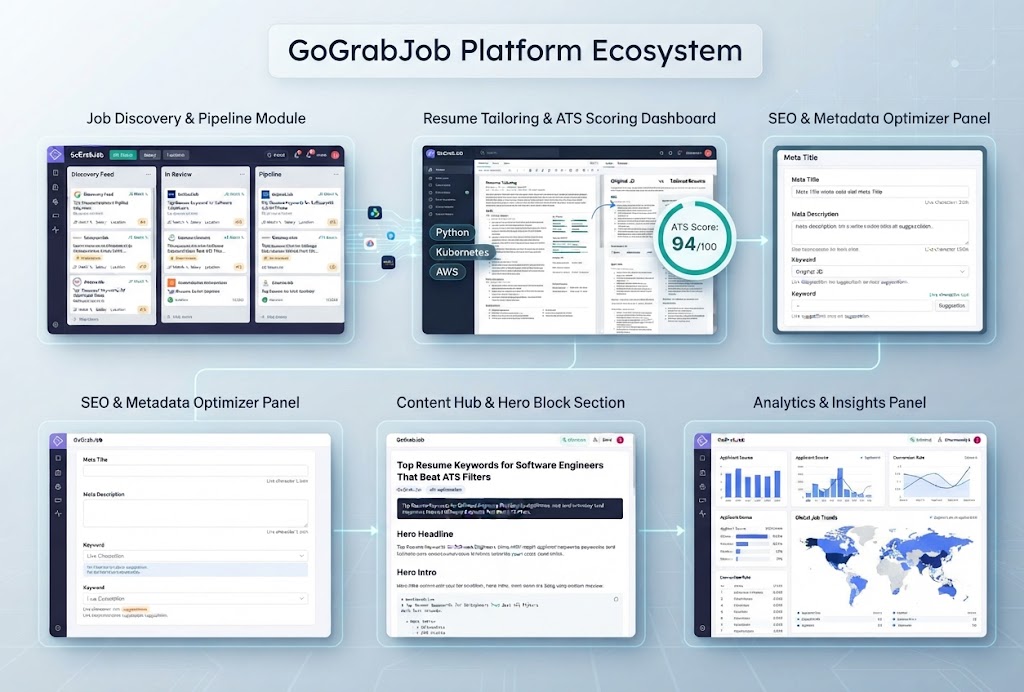
Using an integrated workspace like GoGrabJob transforms how software engineers approach this process. Rather than randomly distributing generic resumes across multiple external platforms, developers can discover openings in a unified, ranked feed aligned with their exact skill set. When assessing high-demand job listings that already indicate heavy applicant competition, GoGrabJob provides a live ATS score and JD-tuned resume recommendations before you submit. While optimizing your resume keywords and raising your ATS match score significantly improves candidate visibility, job seekers must remember that no tool can guarantee job interviews or eliminate candidate competition on popular roles. Honest positioning, combined with tailored technical keywords, remains the most effective path to landing technical screening calls.
Essential Categories for Software Engineering Keywords
Programming Languages: Python, Java, TypeScript, C++, Go, Rust, JavaScript (ES6+)
Frameworks & Libraries: React, Node.js, Spring Boot, Django, Angular, Next.js, FastAPI
Cloud & DevOps: AWS (EC2, S3, Lambda), Docker, Kubernetes, Terraform, CI/CD, Jenkins
Databases & Storage: PostgreSQL, MongoDB, Redis, MySQL, Apache Kafka, Elasticsearch
Architecture & Concepts: Microservices, RESTful APIs, GraphQL, System Design, Distributed Systems
Methodologies & Testing: Agile/Scrum, Test-Driven Development (TDD), Unit Testing, Jest, CI/CD Pipelines
Core Technical Resume Keywords Every Engineer Needs
To build an ATS-compliant resume that passes digital filters and resonates with senior technical interviewers, you must organize your technical keywords strategically. Recruitment screeners look for specific groupings of skills, including primary programming languages, modern frameworks, data infrastructure, and system design concepts. Simply dropping a block of unformatted technical buzzwords into a skills footer is no longer effective; contemporary ATS algorithms analyze keyword context, proximity to job duties, and demonstrated achievements.
When listing technical skills, categorize them cleanly into distinct functional areas. For backend engineers, explicitly listing terms like Microservices Architecture, RESTful API Development, Database Indexing, and Distributed Systems signals depth of expertise. For frontend developers, terms like State Management (Redux/Zustand), Responsive Web Design, Web Performance Optimization, and Component-Driven Development are crucial keyword signals. Full-stack developers should ensure both client-side and server-side ecosystems are explicitly stated using official vendor naming conventions.
Furthermore, technical action verbs and impact keywords must accompany your hard skills throughout your work experience section. Avoid passive statements like 'was responsible for building APIs.' Instead, write compelling bullet points using high-impact keywords such as:
- Architected and deployed microservices backend services using Go and gRPC, reducing end-to-end API latency by 35% across 250,000 active daily requests.
- Implemented automated CI/CD pipelines via GitHub Actions and Docker, accelerating engineering deployment frequency from weekly to daily releases.
- Refactored legacy monolithic PostgreSQL queries, optimizing database index structures to cut query execution time by 50%.
Integrating technical keywords naturally into outcome-driven statements satisfies both automated ATS screening filters and the exacting standards of human peer reviewers during technical resume evaluations.
Stay Updated
Get the latest career insights and job search tips delivered to your inbox.
We'll only email you about new blog posts. Unsubscribe any time.
How to Tailor Your Resume Keywords for Every Application
- 1
Analyze the Job Description
Identify core tech stack requirements, required experience levels, and explicit language conventions used in the job posting.
- 2
Compare Syntax and Acronyms
Ensure your resume contains both full terms and common abbreviations (e.g., Kubernetes and K8s, Continuous Integration and CI/CD) as listed in the target JD.
- 3
Check Your Live ATS Score
Use GoGrabJob to run a live ATS diagnostic match against the target job description to pinpoint missing technical keywords.
- 4
Save Application-Specific Versions
Store each tailored resume version inside your job tracker pipeline, allowing you to review exact keyword focus when invited for interview preparation.
How to Tailor Resume Keywords to Specific Job Descriptions
A common mistake software engineers make is submitting a single, static resume to dozens of distinct tech openings. A backend engineer role focusing on high-throughput data processing in Java requires a completely different keyword distribution than a cloud-native backend position utilizing AWS Lambda and Serverless architectures. Applying a generic resume across varied job postings significantly lowers your average match score on modern recruiting platforms.
Effective keyword tailoring requires analyzing individual job descriptions to isolate required hard skills versus secondary preferred requirements. Pay close attention to how the employer phrases their stack. If a job listing emphasizes 'AWS Cloud Services, DynamoDB, and Infrastructure as Code (Terraform),' using generic phrasing like 'cloud experience' will fail to trigger key ATS match parameters. You must reflect the specific terminology of the role within your professional experience bullets and dedicated core skills matrix.
Managing tailored resume variations manually can quickly become overwhelming when managing multiple job searches. GoGrabJob solves this fragmentation by offering a complete, end-to-end application management pipeline. Within the platform, software engineers can discover roles across global regions, evaluate match strength, generate JD-tuned resumes with live ATS scores, and automatically track application statuses in a unified workflow. Every tailored resume version is saved directly to its respective application card. When recruiters reach out to schedule code reviews or technical interviews, candidates can immediately retrieve the exact resume version submitted, ensuring seamless consistency throughout the entire interview preparation phase.
Frequently asked questions
What are the most important resume keywords for software engineers?
The most critical resume keywords for software engineers are specific hard technical skills matching the job description, including primary programming languages (Python, Java, TypeScript), frameworks (React, Spring Boot, Node.js), cloud platforms (AWS, GCP, Azure), databases (PostgreSQL, MongoDB), and system design practices (Microservices, REST APIs, CI/CD).
How do ATS algorithms handle acronyms versus full technical terms?
Modern ATS filters parse technical text contextually, but older parsing systems may search strictly for exact text strings. To maximize match compatibility, include both acronyms and full spelled-out terms on your resume—for example, writing 'Kubernetes (K8s)', 'Amazon Web Services (AWS)', or 'Continuous Integration and Continuous Deployment (CI/CD)'.
Can keyword stuffing get a software engineer resume rejected?
Yes. Keyword stuffing—such as repeating skills excessively or pasting invisible white-text keyword blocks—can trigger modern ATS anti-gaming penalties and instantly alienate human technical recruiters. Always integrate keywords naturally into contextual, metric-driven bullet points that reflect genuine engineering experience.
Run your job search in one workspace
Find roles ranked to your profile, tailor your existing resume for each job, score ATS fit, and track applications — free to start.