Decoding the AI Job Match Breakdown: Beyond Keyword Matching
In traditional job searching, candidates spend hours scrolling through disparate boards, manually comparing job descriptions against their work experience. You type keywords like 'Senior Product Analyst' or 'Frontend Developer' into a search bar, only to receive thousands of mixed results ranging from entry-level internships to executive positions. When you evaluate positions in a modernized job workspace, understanding why this job match score appears next to a vacancy is the key to transforming how you navigate the job market.
Modern AI matching systems do far more than check whether a exact word exists on both your resume and a job description. Instead, an AI job match breakdown analyzes the deep semantic relationship between your professional profile and the employer's expectations. Rather than relying on simple string searches, intelligent algorithms evaluate core competencies, domain experience, tools, project scale, and contextual nuances. For example, if a job opening requires expertise in data visualization with Tableau and SQL, an advanced engine understands that your prior work in PowerBI, Python analytics, and relational database management forms a strong adjacent fit, resulting in a high match score even if exact wording differs slightly.
In fast-growing employment hubs across India—such as Bengaluru, Gurgaon, Mumbai, and Hyderabad—job seekers face immense competition across tech, finance, and digital marketing sectors. A single opening can draw hundreds of applicants within hours. Having a single aggregated job feed that automatically discovers listings across multiple platforms and orders them by ranked compatibility saves candidates dozens of hours each week. Instead of spraying applications blindly across every open position, seeing a transparent match breakdown gives you immediate clarity on why a specific opportunity aligns with your unique background.
Key Data Points That Drive Your Profile Match Score
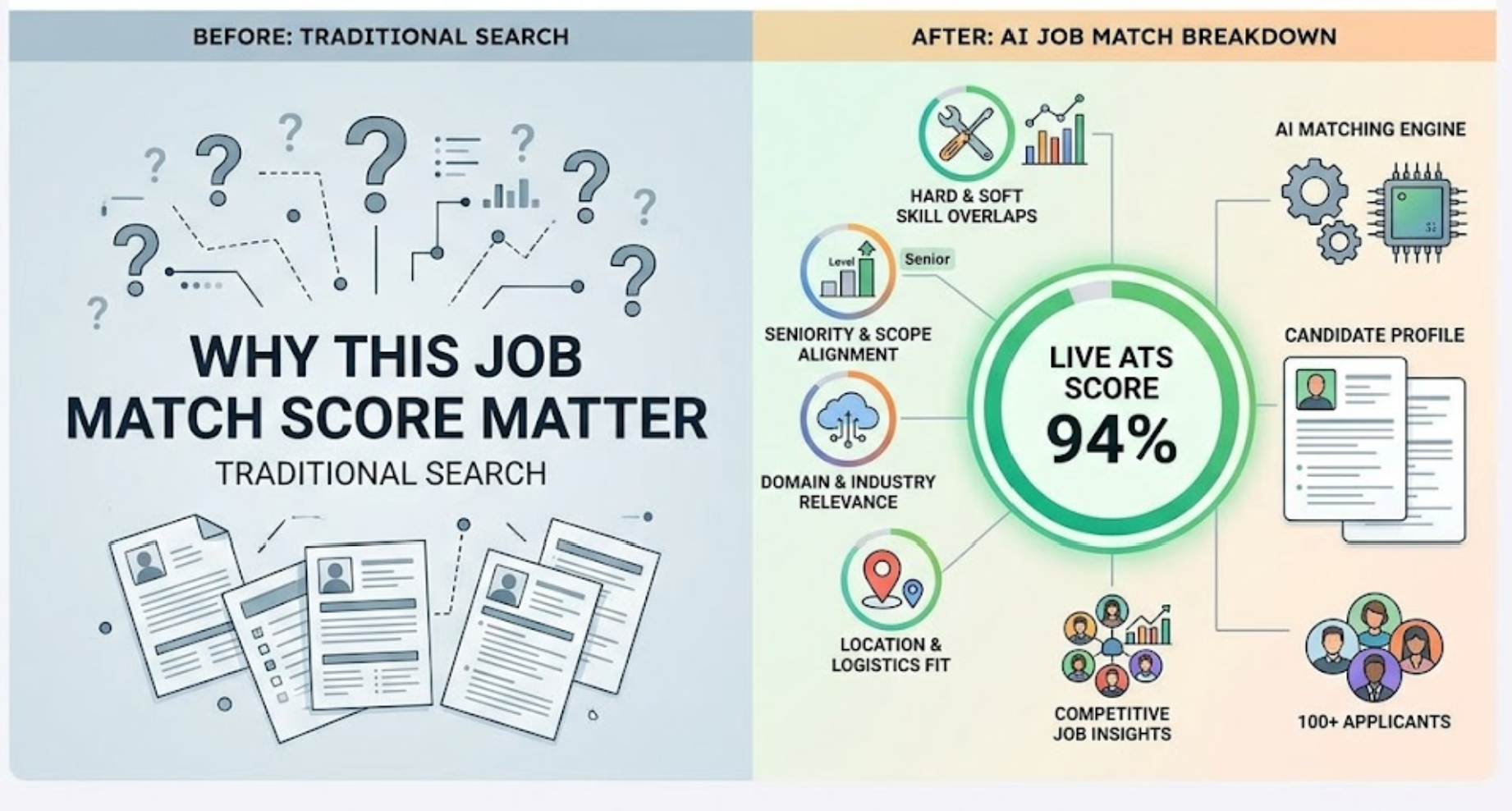
To effectively use match scores, candidates must understand the specific data points evaluated during a profile breakdown. An AI engine processes multiple layers of your candidate profile against active job descriptions to construct a comprehensive match percentage:
- Hard and Soft Skill Overlaps: The algorithm maps your technical tools, programming languages, certifications, and industry-specific methodologies against the mandatory and preferred qualifications listed in the role description.
- Seniority and Scope Alignment: Experience metrics evaluate your total years of work, leadership history, and project scale to ensure you are neither underqualified nor drastically overqualified for the responsibilities described.
- Domain and Industry Relevance: Prior exposure to specific domains—such as FinTech, SaaS, E-commerce, or Healthcare—carries weight in calculating contextual match strength.
- Location and Logistics Fit: Salary expectations (such as LPA ranges standard in the Indian job market), remote work preferences, and geographic proximity influence overall compatibility.
Furthermore, competitive job insights provide critical context alongside match scores. When data exists, seeing applicant competition signals—such as an indicator showing that a popular role already has 100+ applicants—helps you decide how to allocate your time. High candidate volume does not mean you should abandon an application, but combined with a 90%+ job match score, it signals that you must submit a highly optimized, tailored resume immediately to stand out from the crowd.
Using Match Scores to Prioritize Applications and Avoid Spray-and-Pray
The traditional 'spray-and-pray' strategy—submitting dozens of generic resumes every day in hopes of a callback—is statistically inefficient and leads to rapid job search burnout. Recruiters and applicant tracking systems routinely filter out candidates whose applications fail to demonstrate clear role alignment. By leveraging match score breakdowns, job seekers can adopt a targeted, high-conversion application workflow.
When your candidate workspace presents opportunities in a ranked feed based on fit rather than posting date alone, your daily job search changes fundamentally. You can focus your prime energy on high-match roles (typically 80% or above) where your profile strongly meets employer expectations. For mid-range match scores (60% to 75%), the match breakdown highlights missing competencies or experience gaps, allowing you to decide whether those gaps can be bridged through resume emphasis or if the position requires skills you have not yet developed.
Managing your entire job search journey within a unified workspace pipeline keeps your strategy organized. Moving seamlessly from job discovery to application submission, tracking application status, and accessing role-specific interview preparation ensures that no opportunity falls through the cracks. Global candidates who navigate cross-border opportunities benefit further from workspaces supporting multiple languages—such as English, Spanish, Portuguese, and Russian—allowing seamless profile evaluation regardless of region.
Stay Updated
Get the latest career insights and job search tips delivered to your inbox.
We'll only email you about new blog posts. Unsubscribe any time.
Turning Match Signals into Tailored Resumes and Live ATS Optimization
A high profile match score tells you that a job is worth pursuing, but securing an interview requires translating those matching signals directly into your application materials. Modern applicant tracking systems (ATS) scan submitted resumes for relevant phrases, measurable achievements, and structured formatting before a human recruiter ever reviews the document.
When an AI breakdown reveals why a job matches your profile, it also identifies exact areas where your resume can be sharpened for that specific vacancy. By using a job-description-tuned resume generator, candidates can generate tailored resume variations tailored precisely to the target role's keywords and requirements. Live ATS score calculations provide immediate feedback, showing you how your customized resume scores against the specific job posting in real time.
Crucially, keeping track of tailored applications requires version control. A workspace that automatically remembers every resume version created per application eliminates post-application confusion. When a recruiter calls weeks later, you can instantly review the exact resume variant submitted for that specific role. Honesty remains vital throughout this process: AI toolsets cannot guarantee interviews or magically eliminate applicant competition on hot roles, but they provide the structured clarity required to present your genuine qualifications in the strongest possible light.
Frequently asked questions
What does a job match score actually mean in modern job searching?
An AI job match score measures the contextual and semantic compatibility between your candidate profile (skills, experience depth, domain knowledge, and preferences) and an open job description. Higher scores indicate strong alignment with the core requirements of the role.
How does understanding why this job match score is calculated help me fix my resume?
The job match breakdown highlights both matched skills and missing qualifications. By reviewing these specific signals, you can adjust your resume phrasing, highlight relevant past projects, and boost your live ATS score before submitting your application.
Can a high match score guarantee an interview or eliminate competition?
No. A high match score indicates strong candidate fit, but it cannot guarantee an interview or reduce competition on popular roles that receive hundreds of applications. However, combining a high match score with a tailored resume significantly improves your chances of passing initial ATS screens and catching a recruiter's attention.
Run your job search in one workspace
Find roles ranked to your profile, tailor your existing resume for each job, score ATS fit, and track applications — free to start.